New Horizon Pro Wrestling
Inside the mind of Korvus: Building a villain, one Perth show at a time


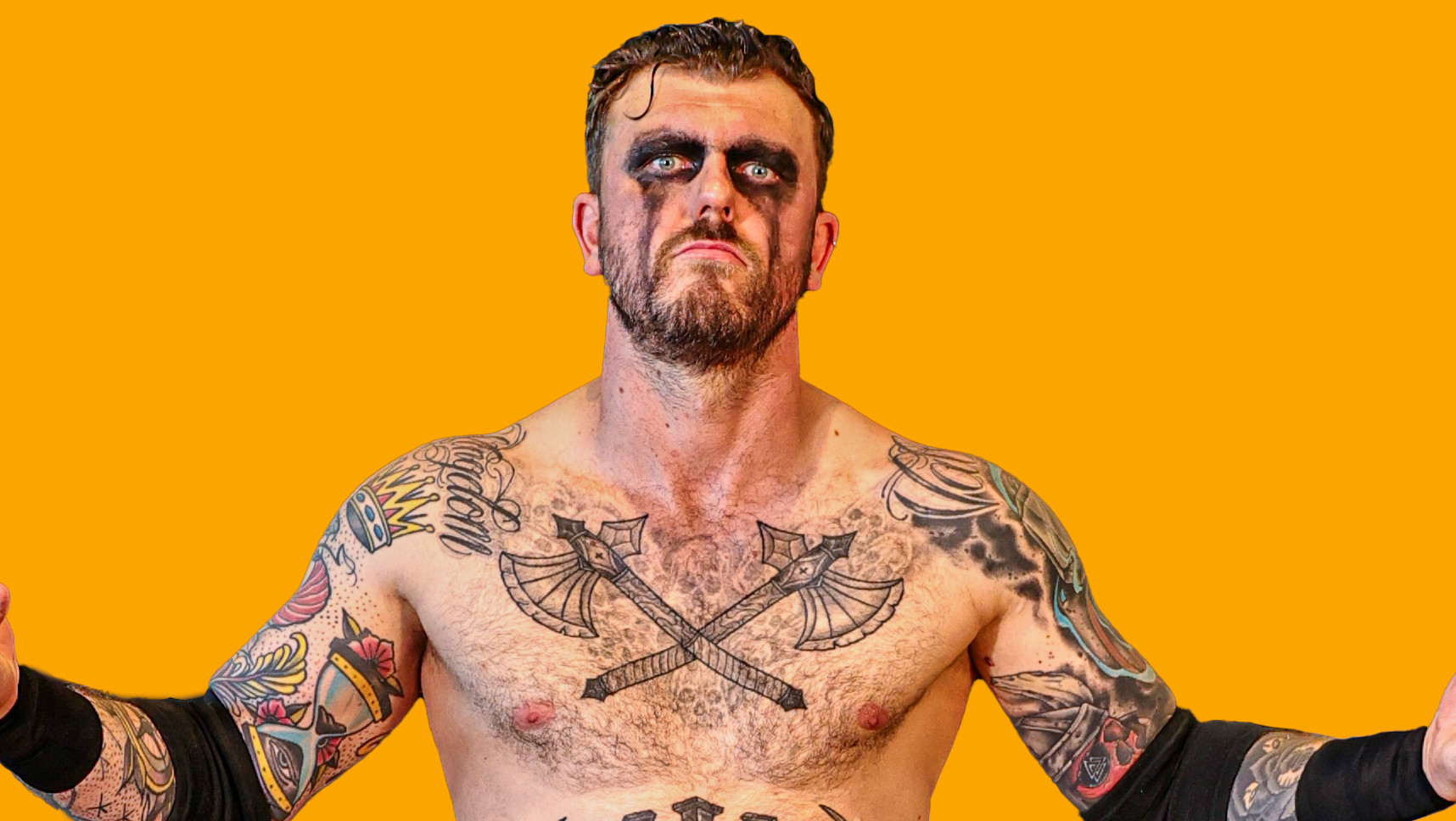
Pete Morgan has been wrestling for five years. The most significant portion of which has been spent doing death match for DMDU while also training the next wave at Malice Wrestling Federation. He is made of kintsugi philosophy, MMA retirement, light tubes, rugby league instincts, and a degree of self-awareness that has recently led him somewhere important: toward help.
Image credit: @jhmedia.jpeg
He has just had a death match in his hometown against Joel Bateman. After that, he doesn’t know how long he’ll be away. He sat down with In the Gorilla Position to talk about tempered glass and trust, the art form he found in the place most people look away from, and why he’d rather see you cry at 3am than read your name on a tombstone.
There is a Japanese art form called kintsugi. When a ceramic piece breaks, you repair it with gold, filling the cracks, making the fracture visible rather than hiding it, revealing the history of the object rather than pretending it never shattered. The philosophy holds that something broken and repaired is more beautiful than something that was never broken at all.
Pete Morgan has built his entire character around this idea.
“The broken heart (his character) was destroyed by life, but brought back together by wrestling. That’s the gold in the heart that put him back together.” He pauses. “He was broken by life, but he’s alive because of wrestling.”
This is not, he makes clear, purely a performance. The character is him: not amplified or dialled up, but channelled. The brokenness is real. So is the gold.
The moment that cracked things open for him was a pay-per-view. AEW Revolution 2020. He had been a wrestling fan long before that and doing stuff on the trampoline as a six-year-old, the usual story, but something about that particular night was different.
“I was watching Jericho and Moxley. I knew who they were. But I don’t know, it was something about the whole match itself, and then watching the end. Something clicked. And it was like, yeah. This is what I want to do, and now I need to do this.”
The next day he was looking for schools. He had a tryout booked at MCW (Melbourne City Wrestling) in April 2020, which is the single worst month in recent history to have booked anything.
“Yeah, yeah. Worst timing in the world.”
He spent the pandemic years going to local shows instead, like Wrestle Rock, where he saw Mad Dog, Vixsin, Avery, Jimmy Havoc, Mitch Waterman, Jaratha. He followed GCW, the Geelong promotion. He found a pamphlet at one of their shows advertising Relentless and their school out in Melton, which was half an hour from Werribee, which was close enough.
“Rocked up on the first day, paid the fees, was like, all right, let’s do this wrestling thing. Got through the end of the session and I almost died.”
He describes sitting beat-white in the corner, barely upright, having discovered what a wrestling training session actually involves. He came back the next day. And the day after that.
“It was my determination that got me through day one. I was not rocking up here with everything behind me just to fail first day.”
Five years later, here he is.
There is a thing people in wrestling say about the five-year mark that it’s a hump, a test, the point at which the passion either cements or evaporates. Pete has been in long enough to have an opinion on this.
“Honestly, yes and no. It really depends on the people you surround yourself with.” He thinks about it. “Five years is a good benchmark because the first year you don’t even wrestle. It’s just train, train, train. The second year is when you start wrestling and you’ve got to learn to navigate that. It’s step by step, but it does take a long time. And there are still things, even after five years, that I don’t know.”
The real answer to the five-year question, he suggests, is not about whether the passion survives but whether you have built something worth sustaining. Whether you have found your people, your purpose, your style. Whether you know why you’re still doing it.
Pete knows why.
The death match came to him through the back door. After he started training, he found work backstage for Death Match Down Under (DMDU) and his first show was the Juice’s Worth the Squeeze tournament.
“There wasn’t too much death on the card. But there was a big death match at night two between Cal and Gweedo. And it was like, okay. This is more of what I saw between Mad Dog and Jimmy Havoc. I get it. Cool.”
He became friends with Joel Bateman, the same Joel Bateman he will face in his hometown tomorrow night. And Bateman opened a door for him.
“He showed me guys like Jun Kasai, Masashi Takeda, Shuji Ishikawa. Guys in America like Alex Colon and Matt Tremont. And it started off as something I couldn’t look away from. How you see a car accident. But you don’t look to help: you look out of curiosity.”
Then the curiosity deepened into something else.
“The more I watched it and the more I understood the wrestling itself, it sort of just morphed together. And I was like, no. This is cool. This is like an art form. It’s how they tell their story.”
He gets specific about what he means. In sports entertainment, you tell stories through performance and spectacle. In technical wrestling, you tell them through the body’s vocabulary of holds and counters. In death match, the story is about durability and who can absorb the punishment and keep going, who can take what the world throws at them and refuse to stay down.
“That’s what I think the basic story of a death match is. It’s who’s more durable.”
He is also careful, insistent even, about the craft involved in the apparent chaos. He has done two years of death match refereeing for DMDU, and he takes the safety architecture of the form seriously in a way that will surprise anyone who hasn’t thought about it.
The glass, for starters. You need tempered glass, not regular window glass. Tempered glass shatters into small cube-shaped shards. Its like safety glass in a car windscreen. Regular glass breaks into long blades that can go through a person."
“If you use regular glass, they break into shards this big and they stab straight into you. Like a knife through sick. That can kill you if you’re not careful.”
The referee’s role in death match is different to anything in regular wrestling. They are not there to count pins and monitor rules. They are there to ensure nobody dies.
“You’ve got to have trust in your referee because the referee is there to keep you safe. Like, to make sure you don’t die. There are some I’ve worked with that I trust more than others, because they’ve really put the hard work in to learn what is dangerous and they’ve gone out of their way to learn first aid.”
He references Lady Refington, the New Zealand referee he has worked with and her TikTok framing that wrestling is fundamentally about consent: permission to access your body. He met her the day before a death match tournament when DMDU went to New Zealand, and she worked ringside at Reaper Pro’s Ready to Die show.
“She’s a very good person.”
He had done MMA for years before wrestling. Retired from it due to a lower back injury (a bulging disc) and came into wrestling wondering whether that would end things before they started.
“My first big question was, I have a lower back injury. Will that affect it? And they said, once you get over the hump of learning to bump on your upper back, you’ll be fine.”
He learned to bump differently. The injury that ended his MMA career became a technical problem with a technical solution, and he found the solution. He has had no issues since. He mentions Duke Hanson, who he believes had a serious neck injury and had to completely redesign his wrestling style to accommodate it, making it all the way to NXT on the other side.
“I just had a bulging disc. If it was my neck, I’d be screwed.”
But the injury is not the deepest wound the character carries.
“The character I portray, the broken heart, he comes from deep-seated trauma that I’ve had for a long time. Which is why it’s the broken heart. He was destroyed by life, but brought back together by wrestling.”
Outside the ring, he says, he doesn’t always know what to do with himself. The ring is where he is fully present, fully alive, fully himself. Outside it, there’s a different shape to things.
“When I’m out there, it’s who I really am. But when I’m out of there, I don’t know.”
He says this without self-pity, more as an observation. The wrestling is the gold. The rest is still the broken ceramic, finding its way back together.
“It’s not been the healthiest way of doing it. Especially when it comes to death match. I’m not out there to mutilate myself. That’s not why I do it. But the way I use death match is as a way of expressing the pain inside. A way of getting it out.”
He pauses.
“Hence why I like collecting scars. I’ve got a nasty one on my arm from a match that was very important to me. I’ve got a bunch on my back, some on my chest. But I remember the stories of those. Because that’s what reflects inside.”
At the time of this conversation, Pete is getting over pneumonia. Tomorrow night he has a death match in Werribee, which is his hometown, against Joel Bateman, the man who first showed him what the form could be. After that, he doesn’t know how long he’ll step away.
“I want to put a timetable on it, because I do need time away from the business to actually recover. Mentally and physically.”
He has been going through something. He is careful about the details because they are his, but he’s clear about the shape of it. A couple of months ago things were very rough. He had bookings, obligations, the inertia of commitments that kept him going past the point where he should have stopped.
“It was a matter of like, I have these obligations. I have these bookings. I have to do them.”
Now those obligations are winding down. Tomorrow is the last one. After that, he is going to fix things with the knowledge that he has support, that he knows what he needs, and with the particular clarity that comes from having finally admitted that the clarity was necessary.
“Right now I’m in a position where I know I need help. I know what I need to do. I know where I need to go and I know I have support.”
He has made a post to his private Facebook explaining what he has been going through. The response surprised him.
“So many people have reached out and been helpful since I did that. I had no idea up until that point that those people gave a shit.”
He says this not as a knock on them but as evidence of something he wants other people to understand before they reach the point he reached.
“Some people may feel alone, or like no one’s going to help them. But as soon as you ask for that help, you have no idea how many people want to help you. It will surprise you how many people do. It surprised me.”
He is not going public with the personal details yet. But the message he wants to carry when he does go public and the thing he hopes his name means in the business long after he stops is this: if someone like Pete Morgan can take the time off, admit he needs help, go and get it, and come back better, then maybe someone else can too.
“If I inspire one person, I’ll be happy.”
He is deliberate about the language he uses here, careful and direct in a way that tells you he has thought about this a great deal.
“We would much rather see you in the crowd, or see you happy, or hell, see you cry than see your name on a tombstone. That would go for anyone close to you. That would go for anyone that you ask.”
He trained MMA because he thought that was the thing. Wrestling turned out to be the thing. And within wrestling, death match turned out to be the specific language his specific story needed.
“I keep going because there are times I have nothing else really. It’s what I’ve wanted for a long, long time.”
He wrestles mainly for DMDU and trains with Malice Wrestling Federation in Pakenham, and he is happy with this. He has wrestled in New Zealand, in Sydney, in Adelaide. He has one remaining dream on the list before he would be ready, one day, to call it done.
“My big goal is just to have a death match in Korakuen Hall. And after that I might be happy to retire.”
He names the friends who have already done it: Vixsin, Dale Patrick, Demetri Alexandrov, Michael Weaver from South Australia who recently teamed with the legendary Abdullah Kobayashi. He watches them do it and thinks: if they can, then so can I.
He is also watching the people coming up behind him with something that reads as genuine investment.
“There are so many good talents coming up at the moment. Guys like Zach Day, Jackson Wilde (he’s been working for two years but he only turned eighteen six months ago). He’s got so long left on the track.”
He wants to make it easier for them. The athleticism, he says, is actually the easy part. The hard part is navigating shows, navigating business, learning all the stuff that doesn’t have a name but takes years to absorb.
“I’ve wanted to make my own legacy, but also make it easier for the people that come after me. Because it’s hard to break out in Australia. It’s getting easier and we’re getting more eyes on us. But we’re ages away from Mexico and America. So if you want to go and make it, you’ve really got to want it.”
When the boots eventually come off, whenever that is, however many returns from retirement it takes, he has an answer for what he wants people to remember.
Not a match. Not a moment. A message.
“To be an example of people looking after their mental health. If you feel you need the time or even if you don’t feel like you need it, but the people around you are saying you do, the best thing for a person is their support network. And if they’re saying you need help, there’s something there.”
He thinks about it a moment more, and lands on something simpler and truer than any kintsugi metaphor.
“Just reach out. Because you are not alone. You may think you are. But you are not.”
Tomorrow night, in Werribee, the broken heart goes out one more time. He is going to leave everything on the canvas because it is his last night for he doesn’t know how long, and he wants it to be the best match of his career up to this point. Not a goodbye. A see you later.
“I can’t quit this even if I wanted to. But I can understand when I need time away from it.”
The gold is still holding. He is going to take care of the cracks.
Pete Morgan wrestles as The Broken Heart for DMDU and Malice Wrestling Federation.
If you or someone you know is struggling, please reach out. You don’t have to do it alone. Lifeline: 13 11 14 | Beyond Blue: 1300 22 4636 | MensLine: 1300 78 99 78
If you've read this far, please consider buying me a coffee! It's really expensive here in Melbourne.
comments powered by Disqus