New Horizon Pro Wrestling
Inside the mind of Korvus: Building a villain, one Perth show at a time

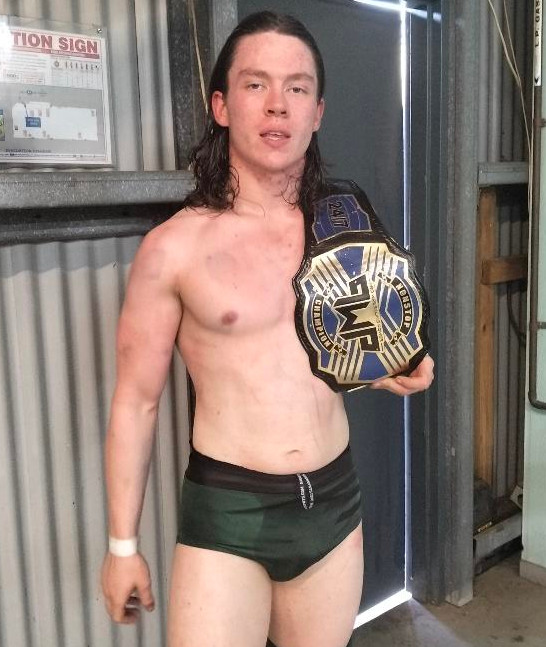
Paddy Fitz is twenty-one years old, Irish, and currently living out of a bag in Cairns while he logs his regional working visa days and gets booked wherever he can. He came from Mayo via Galway via Dublin via Brisbane, and he has every intention of being in Sydney and Melbourne before he's done.
He is a heel because being Irish in Australia makes that very easy, he studies wrestling on a treadmill, he wants to do improv comedy classes, and he has a very clear sense of where he is going and why it matters. He sat down with In the Gorilla Position to talk about Daniel Bryan at WrestleMania, the peculiar arithmetic of the Irish scene, what it means to have ego as a tool rather than a flaw, and why legacy matters more to him than money.
He introduces himself as Ireland’s Ego. It is not, he is at pains to clarify, entirely a character.
“I am a bit egotistical, and to have the goals I have, you kind of have to be, in a way.”
Paddy Fitz is twenty-one years old. He has been training for roughly two and a half years. He started having matches in front of paying crowds this year. He has no fixed address. He’s in Cairns on a working visa, logging regional days, picking up bookings when he can, keeping one eye on Brisbane, one on Sydney, one on Melbourne, one on Perth, and one on Japan, which is a lot of eyes for a man who hasn’t yet settled anywhere.
He is also, unmistakably, a guy who has thought very hard about what he’s doing and why. The ego, it turns out, has done its homework.
He grew up in the west of Ireland, in Mayo, which sits roughly as far from everything as you can get while still being on the island. Wrestling got in the way it gets in for most people. Through a mate. Through a trampoline. Through the specific alchemy of being a kid who has too much energy and not quite enough outlets for it.
“Me and my best mate when I was in primary school was a big fan as well. We were always doing moves on the trampoline, playing with the figures, playing the games. We played the hell out of Raw, Smackdown, all of it.”
Then, as it does, life got in the way. He drifted away from wrestling around 2014. He played Gaelic football. He played rugby union, which later became relevant when he started working out what his finishing move should be. He lived the life of a young man in the west of Ireland, which is to say he was busy and active and not particularly thinking about squared circles.
He came back to wrestling, he says, through CM Punk. He started watching again when Punk returned to AEW, started keeping up with things, found himself genuinely hooked again. But the match he names as the first one that made him feel something and really feel it, the way you feel a match you see as a child is different.
“The first match I vividly remember being in awe of, where I was like absolutely hooked?” He pauses, almost sheepish. “It was Sheamus’ moment in the sun at WrestleMania.”
He grins at his own phrasing. It was, he acknowledges, the kind of match that wrestling purists roll their eyes at. But he was a young Irish kid watching a big pale ginger stand in the main event of the biggest show in the world with the title in the air, and something in his brain went sideways.
“As much as everyone hates that match, the young little Irish guy seeing the big pale ginger live it up on screen, yeah. That’s what got me hooked.”
The first match he ever stumbled across, he adds as a footnote, was an old Elimination Chamber with Big Daddy V and all that he found while scrolling through YouTube at his aunt’s house. “I was like, how do they even get people to look like this?”
Between the trampoline moves and the Elimination Chamber and Sheamus’s moment in the sun, wrestling had made its way into him deeply enough that, when the opportunity finally presented itself, he couldn’t pretend otherwise.
Here is the problem with trying to become a professional wrestler in Ireland, as Paddy explains it with the brisk efficiency of someone who has done the sums many times.
Australia has sixty-one promotions, approximately. Ireland has five.
“If you run a show once a month, that’s one weekend per promotion. You do the maths.”
There are good things about this. The scarcity means quality. Every show he’s been to for OTT (Over the Top Wrestling), the premier promotion in Ireland, has been outstanding and the kind of event where he’s watching the card and thinking everyone on it is about to get signed. The school he attended in Ireland was OTT’s feeder. The talent that comes through it is, he says without hyperbole, world class.
“For as small a country as Ireland is, you cannot beat the quality you get there. I’d get anyone I could to just look up a few of the shows they have OTT on demand, you can get every show they do. Just watch even one and you’ll be blown away.”
He lists names: Cian Noonan, who recently got a WWE tryout. Jay. Bittersweet Josh. Nathan Murphy. Frankie Vendetta. Terry Tatcher. Paddy Morrow. He is generous about the people who helped him and could go on with names all day, effusive in a way that’s clearly genuine rather than performed.
“There is not one bad person on that scene who didn’t put in the time to help me out while I was there.”
But here is the other side of the arithmetic: with five promotions and a finite number of spots, the path to getting reps, real matches, paid crowds, consistent ring time is really narrow. The best get booked. Everyone else waits.
He was also dealing with a geography problem. He trained at Blackout Academy, then moved to Dublin for the School of Irish Wrestling, then managed sessions at Fight Factory, the school opened by Finn Bálor. But he was moving between Galway, Limerick, Mayo and Dublin in a country where those distances represent real commitment and real expense.
“I’d be travelling four or five times a week, give or take, and the fuel cost? If I wanted to move over here (to Australia), it just wasn’t doable.”
There was a period of four to six months in Mayo where he simply couldn’t train. No scene in the west of Ireland, no reasonable route to anywhere that had one, no way to make it work. He stopped. He waited.
When he decided to come to Australia, he stopped again for a month or two before leaving. This was partly logistics, partly saving, partly accepting that a short-term sacrifice was the price of a long-term bet. He came over by himself. His mate fell through. His cousins are in Melbourne.
He landed in Cairns, got a job, found there was a school and a promotion there, and thought: sweet as.
The character, he explains, practically builds itself.
“As simple as ‘I am Irish, I’m better than you’. They get that. You know? And that gets the job done.”
He is working here as a heel, and being Irish in Queensland or anywhere in Australia, really, provides a ready-made gimmick with almost no setup required. The built-in chip on the shoulder. The very specific brand of national pride that tips easily into insufferability. The accent that is charming until the man wearing it starts explaining why his passport makes him inherently superior.
“I like to take the mic off whoever the announcer is and put the cheeky promo in before my matches. I love it. I don’t know if they always understand what I’m saying but as long as I’m saying I’m Irish and I’m better than you, they get it.”
The language barrier, he adds with a laugh, is sometimes a feature rather than a bug.
He is careful, though, to be clear about something: this is not a permanent identity. It is a sticking point (his word) something that makes him unique at every promotion he walks into on this continent, but not something he intends to ride forever.
“I can guarantee you two years from now, I won’t be doing ‘I am Irish, I have an Irish passport, I’m better than you.’ I don’t want to lean into it that much. I want to show that I have range.”
He invokes Chris Jericho as the patron saint of reinvention. The man who always seemed to sense when a character was approaching its ceiling, who made the change before it was forced on him, who kept being over across five decades of wrestling because he never got comfortable.
“Jericho knew when something was coming towards the end. And then with a click of fingers, he got that change. I’m not going to make out I’m at his level with it, but if you don’t have your eyes open to the fact that you need to change? I think you’re being a bit deluded.”
The character is ninety percent him, he says. Ten percent is the performance layer ie. the dialed-up version, the ego amplified past the point where real life would allow it.
“Like, I don’t mind Aussies. They’re not that bad. They get a few slides. Just on the slides.”
He describes, with barely concealed delight, a recent tag match for Wrestling Allegiance in Rockhampton. His partner was the most-over person at the show. Paddy, by his own count, had approximately five legal moves across the entire twenty-to-twenty-five-minute match.
“It was all cheap little bits like running back behind the curtain, coming out the other side of the building, pulling down the tag partner, knocking him out, distracting the ref, coming in and hitting a low blow. Just the funnest stuff.”
He had the most heat he has ever generated. Everyone in the building hated him specifically. He had done almost nothing that would qualify as wrestling.
“Everyone’s eyes were on me at certain points. They were reacting to me. And I hadn’t done anything.”
He tells this story not as a confession but as a discovery. This is something he learned about what the job actually is. The in-ring work matters, he insists, and he trains for it obsessively. But the work is in service of the reaction, not the other way around.
“You’re there to entertain at the end of the day. As long as whoever turns up is entertained, I’m happy.”
He is a self-confessed perfectionist about the in-ring side. He will beat himself up over a single missed spot even when his opponent is telling him the match was perfect. He describes sitting with that dissatisfaction not as a personality flaw but as a professional necessity.
“If I don’t pick myself up on these things, I think I’m leaving too much room when it comes to improvement. I pick myself on these things because I know where I have to improve. And if I don’t — am I going to achieve my long-term goal?”
The long-term goal is sustainability. Not a title. Well, not just a title, but a life. Getting down to two or three days of day-job work a week. Eventually, none. Being a full-time professional who trains, performs, and spends his spare time on the things that will make him a better performer: gymnastics, comedy nights, improv classes.
“Why can’t I learn more comedy skills from comedy nights? Why can’t I learn all these things?” He mentions a wrestler he worked with who came from a cheerleading background, being able to do backflips, handsprings, the whole vocabulary, and treats it less as an impressed observation than as a reminder that every skill has a source and every source is worth finding.
He does an hour of cardio almost every day. This, he explains, is not just fitness; it is study time. He brings a notepad or his phone, queues up a match from the past, and watches while he moves.
“There’s no way I can watch the worst of matches with nothing going on and not have something working. Oh, I could take influence from this. You always have something going on. You can’t watch a match and not be studying at the same time.”
He talks about his best friend back home in a way that tells you everything you need to know about what kind of support system works for someone chasing something as improbable as this.
“When I told him, he just burst out laughing at first, like, he knew something like this was going to come up at some point. Then he stopped laughing and said, right, I’m done with that, I’m here to support you.”
He values that friend specifically because he knows nothing about wrestling and cares about it approximately as much as he cares about professional curling. This, Paddy explains, is not a limitation but an asset.
“I can run anything by him from an outside-the-business perspective and he gives me the blunt answer. He gives me the side of someone that would just turn up because they heard there’s wrestling on at the local spot. Why not, we’ll go for the evening.”
Friends and family, he acknowledges, would probably rather he had chased the lawyer or the doctor. He understands this. He does not particularly resent it.
“You don’t have to like it. Just be happy. Just be supportive. That’s all I want to hear.”
He has found his people in Australia too in Queensland, in Brisbane, where he trained under Damien Slater and was, he says, blown away both by the teaching and by the level of the other trainees. In Rockhampton. At the shows he has found his way onto while working his way up and down the east coast on visa time.
“There is generally not a bad bone in the scene. Everyone’s there to help each other.”
He mentions names with the same generosity he brought to the Irish scene: Mickey Ryan, who does backflips on nights out, who Paddy describes as absolutely unbelievable and destined. Dom Black from Yorkshire, trained by some of the greats of the English scene. Freaknyxx, who goes all over and has a character unlike anyone else on the circuit.
He is, for someone so new and so green, paying close attention to who is around him and what they can teach him. He is also, clearly, the kind of person others remember the kind who shows up, works hard, gives out what he can, and expects the same standard back.
The final question is the one everyone gets, and he gives it the most considered answer of the conversation.
He doesn’t start with championships, though he does mention them wrestling on the biggest stages, the shoot-for-the-stars goal, the kind of thing you have to have in your head even if you hold it loosely.
He starts with something older and quieter.
“I’m a bit of a legacy guy. I’ve had this conversation with friends and family back home — money isn’t the thing for me. Obviously money funds what you want to do, but that’s not the main thing.”
He wants, two or three or four hundred years from now, for something to remain. Not necessarily him by name (though he wouldn’t mind that) but something. Some trace of the fact that he was here, that he did the work, that it mattered.
“People are going to at least remember, if not me myself, then Paddy Fitz. Some sort of mark on this world. To just be regarded as a good person.”
He is twenty-one. He is living out of a bag in North Queensland. He has a working visa and a spear finish he borrowed from the rugby pitch and a notepad on his phone that you would not be able to fit in ten books.
By the time he is done in Australia, two years minimum, he says, probably more, he has one ambition beyond the bookings and the matches and the grinding work of getting known.
“By the time I’m gone, I don’t think there’s going to be one person in the scene that doesn’t know who Paddy Fitz is.”
Given the way he talks, the way he thinks, and the way he works a crowd of people who can barely understand his accent into a state of genuine fury with five legal moves and a lot of cheek it would be unwise to bet against him.
Paddy Fitz is currently based in Queensland and available for bookings across Australia. He can be found on Instagram. He is Irish. He holds an Irish passport. Make of that what you will.
If you've read this far, please consider buying me a coffee! It's really expensive here in Melbourne.
comments powered by Disqus