New Horizon Pro Wrestling
Inside the mind of Korvus: Building a villain, one Perth show at a time

Nish debuted and created a tagline he blurted out by accident, and no idea what it meant. Through a series of feuds, a room full of people chanting him home, and a mother in the crowd reaching for the ropes on his behalf, he figured it out. Show up. Rise up. Nish up.
Image credit: @najywan
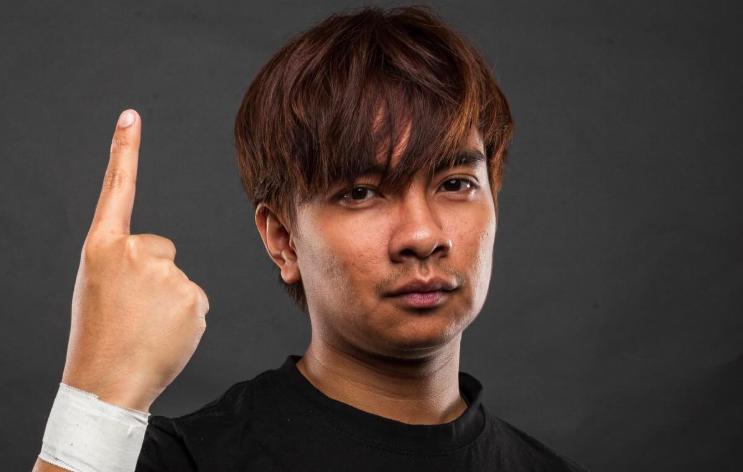
Nish debuted in June 2025. He is eight matches into his wrestling career, stands somewhere between 159 and 163 centimetres depending on which clinic he visits, and has accidentally invented a personal philosophy that people are now using in their daily lives. He is a trained actor, a wedding MC, and a man who has spent most of his performing life in somebody else’s shadow until he found something he could control entirely himself. He sat down with In the Gorilla Position to talk about the Undertaker at age four, his Stardust era, a tagline he said because he forgot what else to say, and why being a big fish in a small pond is only half the point.
The tagline was an accident.
He was in his second match. He looked around, and decided to do something with it.
“I say Nish. You say up! It’s never planned. Nish! Up! Everybody said up.”
Then he got beaten up. That part was planned.
The promo that followed was supposed to sell the next match. In the moment, reaching for something, he said: Get ready to Nish Up! Immediately he knew it was wrong.
“In my mind that’s a stupid line. Why did I say that? But then it took me a while to figure out okay, if I already said it, I need to commit to it.”
His wife asked what Nish Up meant. He had no answer. He genuinely did not know.
What happened next is the thing. He started working a series of matches with his opponent Tydus which was his first real feud, pre-show level, but a feud with a shape to it. And in watching those matches take form, the theme emerged by itself. He kept getting back up. He kept resetting. He kept returning worse for wear and somehow not finished.
“I realised that Nish Up isn’t just words. It shouldn’t be just words. Nish Up should be something like, being ready to face adversity. Gearing up to be better than before.”
Show up. Rise up. Nish Up.
He has eight matches. The phrase has already reached people outside the wrestling world.
His in-ring name is close to his real name and is deliberate as it is a play on the word niche, and he enjoys that a name which means specialised, focused, specific, also doubles as a reminder about the kind of market he operates in.
“Not everyone will like me. Not everyone will love me. But as long as I have my niche group that will want me to succeed, want me to be at my best, that’s my niche group.”
He was performing long before he was wrestling. From childhood, he had been building toward a specific moment: a place in Singapore’s television landscape, specifically the Malay-language channel, one of four main broadcasters in the country. The path ran through a reality competition. It was a talent search program that ran for ten weeks where he became the male runner-up at nineteen going on twenty.
At that age, already, he understood something about how attention works. He had his family come to the tapings, obviously. But he also had friends make postcards with his name on them, told them specifically not to identify themselves as people who knew him, and instructed them to show up, make noise, and create the impression of a fanbase.
“In business it’s kind of like creating a demand for yourself. When you see a group of ten people here cheering for him, I would want to cheer for him too, because these people believe in him. You don’t need to know that these people are planted.”
That instinct that perception creates reality, and that a performer’s first job is to give the crowd a reason to invest has followed him directly into wrestling. At his debut, his immediate family were there. On film, you cannot tell family from believers. You only see people who are loud, and loudness reads as conviction.
The acting career that followed the talent search was real but frustrating. For five years, he worked. He got cast. He was in shows. And he was never the man on the poster.
“For five years I was always playing somebody’s brother, somebody’s lackey, somebody’s comic relief. I didn’t like that at all.”
He wanted dramatic weight. The husband whose wife died. The difficult, serious character that demands something from the actor. Instead he was necessary but peripheral. The supporting part. The character the story uses to move information around.
He references Cody Rhodes when he explains what he did with that frustration. Not because he went through the same events, but because the shape of the story rhymes.
“At one point I was unhappy with my position. I wanted to play serious roles, dramatic roles. And I was in my Stardust era while I was acting.”
He did not announce a departure. He simply stopped making acting his priority. He describes it as going cold turkey, removing himself from the thing that had shaped half his life, landing in a nine-to-five with nothing to fill the space that performance had occupied.
“You wouldn’t want to put me in a box, put me in a cage. I need to express myself. I need to be big. I need to perform.”
Wrestling found him at the right moment. Or he found it. Either way, June 2025: debut match, Grapplemax Pro Wrestling , Singapore.
The first time he actually saw wrestling, he was four years old. His family was in Johor, visiting, and there was something on the television.
A man in a black leather trench coat was walking toward a group of people and destroying them. One of them was a white man with dreadlocks.
“That would be the Undertaker.”
He describes it in detail that has clearly been recalled and polished by years of loving it: X-Pac running toward the Undertaker first, then Road Dog, then the rest and one man in particular sliding all the way down the ramp from a single punch.
Then he was told to go back to sleep. The lights went out on the television. He did.
The second moment, the one that truly took hold, came later. His grandmother was watching a two-hour Raw and an entire hour was devoted to one match: Shawn Michaels versus John Cena, an iron man match.
“I have a very short attention span even as a kid. But I can be glued to the TV just watching that match, because I don’t understand what’s going on but the storytelling was there.”
He physically moved closer to the television. He did not understand what he was watching. He understood completely what he was watching.
“At that moment, yes! I love this thing.”
He does not copy Shawn Michaels. He wants to be clear about that. He does not do the moves, does not chase the flips. He is, he says freely, scared of heights, and would only go to the top rope if the story demanded it and the stakes were high enough.
What he studies in Shawn Michaels is how to react. How to receive a move, how large or small to sell it, how the size differential between him and an opponent changes the appropriate response.
“There are certain bumps where you can sell it small, you can sell big. You can sell like you got shot in the back.”
He describes the specific detail that lives in his head: the way Michaels, when hit from behind, would collapse like he’d taken a bullet. The body first, then the rest of him catching up. Big mobility selling. Then he contrasts it against what would happen if a smaller man hit you, versus a larger one, versus a punch versus something heavier. The calculations are constant.
“It doesn’t mean that you need to copy them a hundred percent. Sometimes you need to study this, okay, take your time, there are certain bumps where you can sell it differently.”
The match that lives in him most is not a Shawn Michaels singles contest but the one that features him in it WrestleMania 24, Ric Flair’s retirement match. The story going in: if Flair loses, he is forced to retire. Michaels knows this. The crowd knows this. And the match is built on the question of whether Michaels can bring himself to be the one who ends it.
“I’m sorry. I love you.”
He says it quietly, the phrase from the match, and for a moment it is clearly not an old wrestling line but something he has thought about more than once.
“Just the look on his face. As a kid, these two people would be old-timers at that point. And you can feel the emotions throughout.”
This is what he is reaching for in his own work. Not the moves. The look on the face.
He is, as he describes it, relatively short even by Asian standards. Somewhere between 159 and 163 centimetres, depending on the equipment. He finds the variance baffling and slightly suspicious.
“Sometimes I’m 159. I’m like, that doesn’t make sense. Your meter is wrong.”
His most recent match before this conversation was for the Grapplemax Pro Wrestling Rising Championship against Ban Sachak, who is half a head taller. In wrestling terms, this is its own story before anyone opens their mouth: slightly undersized challenger, fighting someone bigger, not wrestling like a small man.
“I don’t wrestle like a small guy. I’m very much a showman. I’m very much in character.”
He is not a diver. He is not a high-flyer. He is a performer in the more theatrical sense, focussing on the expressions, the crowd work, the reactions, the willingness to let the crowd see exactly what is happening inside the character at any given moment.
“When he gives you a kick to the leg, how you react? There’s a lot of story in that.”
He draws the parallel to acting directly. You would not cry the same for a character who gets sick as you would for a character who gets shot. The magnitude of the stimulus has to match the magnitude of the reaction. Overselling small things undercuts big things. Getting that calibration right is the craft.
“It’s like levels. You can play with those levels.”
His favourite match so far, his best night, was also the match where he lost.
He was in the main event. There were around three hundred people in the building. He was working against a babyface opponent in a babyface-versus-babyface match. This is the kind of match where the crowd has to choose, because both people are likeable, and neither is wrong to support.
His mother was in attendance. She was seated at the hardcam side.
During the match, his opponent had him locked in a Boston crab. He was selling it, crawling toward the ropes, the crowd building behind him. And in the moment, selling his pain toward the crowd, he saw her.
“I see my mom. I’m trying to grab hold of the ropes and I’m actually aiming for my mom. Mum, help me! Then after I got pulled back.”
Pulled back to the middle. The hold wrenched back in. The crowd reacted.
“You can hear the sound of, Oh! so loud. Get to the rope. Get to the rope. Then he pulled me back to the middle.”
His mother was standing up. His mother, who he says knew this was scripted and had been told by his father that this is fake, was standing up and trying to get him to the rope.
He tapped out. He lost. People asked him if he was okay.
“People ask me: are you okay? Because it looked painful. I’m like, if you watch the video, once the video is out, you will, I don’t really know, because it’s just me reacting and selling.”
And then outside, the chants. A room full of people all screaming “Nish Up!” as he came through.
“Before that it’s just my family members saying Nish Up. Now I have like a room full of people saying it.”
An influencer had been in the audience. He filmed it, posted it to his social media, talked about being in the main event of a Grapplemax Pro Wrestling show. The comments filled with people who had never heard of Grapplemax, never heard of Nish, saying: I didn’t know we had wrestling in Singapore.
“To me that is a good night. More eyes on the product. More eyes on the people you associate with.”
Grapplemax, he is at pains to say, is not just a promotion with talent. It is a promotion with specific talent. It has three hijabi Muslim women wrestlers, two of whom are twins. In fact, the first twin hijabi female wrestlers in the world, as far as anyone can tell. One of them, Sarah Coldheart, was featured in a magazine’s 40 Under 40 list as a pro wrestler.
“I saw the thing and I was like, wow. It’s possible. And it’s not frowned upon. This is what we do. We entertain.”
The Von Erichs used to be broadcast in Singapore. He learned this recently, putting together the history of how wrestling arrived in the country: older generations who will tell you, unprompted, that they know the claw hold, that they remember World Class Championship Wrestling on television. The pipeline runs deeper than most people assume.
But asking someone today whether they watch wrestling produces two reactions. The first: isn’t that fake? The second: oh, I remember Stone Cold. The Rock. Hogan.
“You get two reactions. One is, you know that thing is fake, right? Two. Oh, I remember Stone Cold.”
And then occasionally a third reaction: an uncle who says, in passing, that he used to watch the Von Erichs. That he knows the claw. That there is a longer history here than the modern product acknowledges.
Nish is performing in that longer history, for a very specific audience, in a very specific market, under a name that is literally defined as a specialised focus area. The layers of this amuse him enormously.
“Pro wrestling in Singapore. You’re already niche within niche.”
He has two answers for when he will know he has made it. One is as a wrestler. One is as an actor, and the distinction matters.
As an actor, someone approached him after a drama he had done ten years ago. The character he played had no redeeming features, was deeply irritating, and well-performed.
“I know that you’re a very nice person (Nish). But I can’t help wanting to throw a shoe at your face because of what your character did.”
He laughs about it now. At nineteen or twenty years old, hearing that your character inspired someone to want to throw footwear at your face took a moment to understand that this was the highest compliment the work could receive. The character was so real it provoked a real response. The character was a success!
The wrestling version of this is simpler, more direct.
“When people stop me while I’m lining up to buy food and say, Hey! you are a wrestler. Can I take a photo?”
That is it. Not the championship. Not the main event. The stranger in a food queue who recognised him for what he does.
And there is a third thing, something beyond even that. If a fan comes to him and says: I use Nish Up as a personal motto. Whenever I feel down, I want to Nish Up. For myself and for my family.
“When that happens? That’s life made.”
He means it in the way that actors sometimes mean it when they talk about the mail they receive about the person who watched their film on a difficult night and found something in it that helped them through. The character changes the world of one person. He is not trying to change all of it.
“I myself couldn’t change the entire world. But I could change the world of one person.”
He wants a kid to be sitting in an exam, stressed, and ask: what would Nish do?
He puts this alongside what Cena did with Hustle, Loyalty, Respect, and what Hogan did with eat your vitamins. These are the things that started as hokey wrestling phrases and became, for specific people in specific moments, actual reminders and a part of society. They’re the things entertainment can do that nothing else can: arrive at the right time, say something that sounds simple, and stay with you when the circumstance makes it mean something.
“Some people look at Hustle, Loyalty, Respect and say yeah, you hustle, you work hard, you stay loyal to your people, you respect people regardless of whatever situation they are in. I want that.”
He is eight matches into a wrestling career. He has not yet figured out what American Nightmare era looks like for him. He is out of his Stardust era, that he knows. He is building something that is genuinely his, in a space where he controls what people see, how he looks, and how he tells his own story. This is, incidentally, the thing that five years of acting in supporting roles could not give him.
“You are in control of your own narrative. As a person, you are in control of your own stuff.”
Show up. Rise up. Nish Up.
He said it because he forgot what else to say, on a pre-show in his second match, to a crowd that wasn’t that large and wasn’t that loud. He committed to it because if you say a thing, you have to mean it.
He still doesn’t entirely know what it means. But he is finding out.
Nish competes for Grapplemax Pro Wrestling in Singapore. He also hosts weddings, where he announces the arrival of the bride and groom with the full weight of a man who knows exactly what a good entrance is worth. He is eight matches in. He will be back.
If you've read this far, please consider buying me a coffee! It's really expensive here in Melbourne.
comments powered by Disqus