New Horizon Pro Wrestling
Inside the mind of Korvus: Building a villain, one Perth show at a time

Nate Hunter is a Western Suburbs Melbourne boy who decided in a year eleven legal studies class that he wanted to be a wrestler. Two and a half years and over one-hundred matches later, he is the villain in most rooms he walks into, a student of the territory era, and a man with very clear goals and zero intention of lowering his voice about any of them.
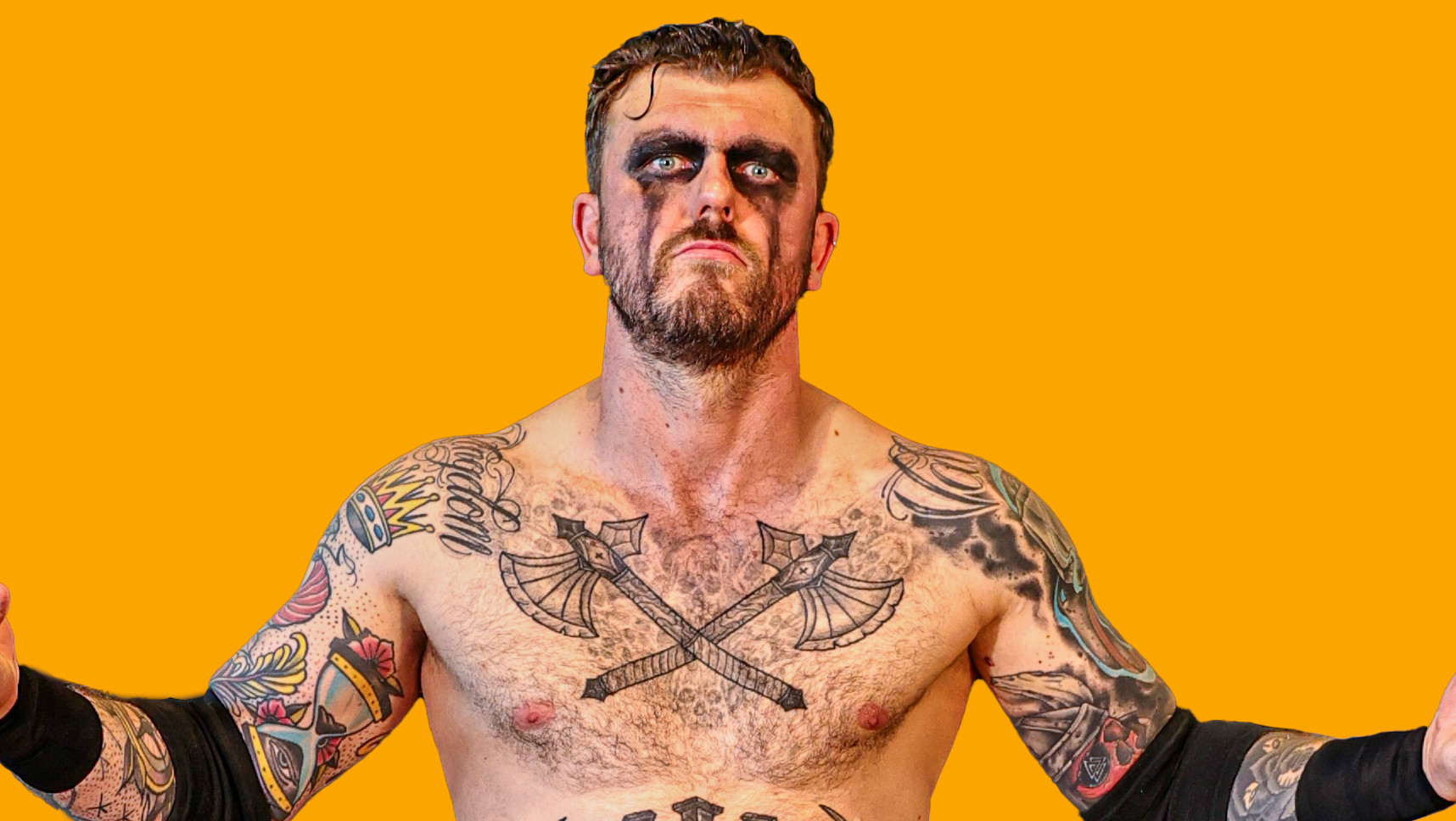
Image credit: Owen Jones
Nate Hunter is two and a half years into his wrestling career, has done north of one-hundred matches, holds the MXW Tag Team Championship with his partner Killian Bates, and will tell you (without the smallest trace of embarrassment) that he is Australian wrestling’s fastest rising star. He is a Western Suburbs Melbourne boy who grew up on comic books and bodybuilding magazines, got hooked on wrestling at age four when he saw Batista strangle Mark Henry with a cord, and found his calling as a heel in year eleven legal studies. He sat down with In the Gorilla Position to talk about MJF, the Carolinas, a mother’s advice that ended a relationship, what Ric Flair has to do with being selfless, and why the kid in the front row is the only opinion that really matters.
He was in legal studies. Year eleven. Bored.
He had been watching wrestling since he was four, had been a fan through all the years it was uncool to be a fan, had copped the “that’s fake” conversation at school more than once and responded, each time, with some version of he did not care.
But it was year eleven, legal studies, somewhere around 2019 or 2020, that everything clicked. He was watching AEW’s early shows on his laptop when MJF appeared and cut a promo. The video game promo. The booing was enormous. The heat was real. The crowd wanted to get through the barricade.
“I saw that and I thought, I want to make people feel that way.”
That was the moment Nate Hunter the wrestler was born. The legal studies class did not get much attention after that.
He was four years old. His family was at his grandmother’s house, his dad and uncle flicking through channels, when they landed on SmackDown.
2007 SmackDown. Batista versus Mark Henry, no disqualification.
“My first match I watched was Batista versus Mark Henry. No DQ. And Batista choking Mark Henry with that cord. And my dad was laughing and my uncle was cracking up.”
He was hooked from that moment, in the way that certain four-year-olds are capable of being hooked on things that will occupy the next decades of their life. He would run home from school on Wednesday afternoons to catch Raw. Run home on Friday nights for SmackDown. The obsession was total and unchallengeable.
He copped it at school for being a wrestling fan. He stuck to it.
“Fuck ’em. I loved it.”
What he loved was what he now identifies, looking back with an adult’s understanding, as the same thing he loved about comic books: those larger-than-life personalities, those physiques, that American storytelling that goes all the way over the top and does not apologise for it.
“I was a big comic book nerd. My father was a bodybuilder. So I was always around that type of thing, like, bodybuilding magazines and encyclopedias all around my house.”
The superheroes and the wrestlers existed in the same part of his imagination. Both featured enormous people with outsized personalities doing spectacular things. The leap from one to the other was not really a leap at all.
He notes, with some amusement, that Spider-Man is also a small guy who talks a lot. The body business is not entirely closed to the shorter man.
The path from fan to wrestler ran, as it often does, through wrestling podcasts and shoot interviews. Around year eleven and twelve, the Stone Cold podcast was everywhere. He kept hearing wrestlers talk about wrestling schools as if they were simply a thing one did.
“They were saying, we went to wrestling school. I thought it was just something you could do in America. I didn’t know you could still do it in Australia.”
He had been going to MCW shows since year nine. He had watched JXT and Gino Gambino and all those guys from the stands. It had never occurred to him that the path from the stands to the ring was accessible from Melbourne.
When it did occur to him, he researched, signed up to the MCW Academy, and the Academy subsequently shut down. He joined Relentless and he stuck at it.
There was a moment along the way, at a family event, where his girlfriend at the time made a joke about his wrestling ambitions. The group laughed.
“I remember my mum walking into my room on a Saturday morning and she goes, Nathan, girls come and go, but if you want to be a wrestler, you stick to it.”
He took that advice.
She is no longer his girlfriend. He is still wrestling.
Ask Nate Hunter for an elevator pitch on his character and he produces one immediately, without hesitation.
“Nick Kyrgios if he was a pro wrestler.”
He explains. Nick Kyrgios, the tennis player is extraordinarily talented, technically gifted, impossible to ignore, and always doing something that makes you want to throw something at the television. Not because he can’t play. Because he always has to do something underhanded that just annoys people.
“Is he insecure? Is he something else? So I would say the part of me that is Nate Hunter. I’m ultra competitive in real life. Nate Hunter is a lot of that, when I get very competitive. When I was playing basketball growing up. Talk a lot. Very loud.”
The character is him, specifically him in competitive mode. Its the version that exists when the stakes are high and the instinct to win overrides everything else. Turned to twelve, then seasoned with inspirations from the louder, brasher end of American sport. LaVar Ball, who would announce before tip-off that his son was going to drop fifty and then watch the son drop four. Anthony Edwards, the young NBA player who is very good and very certain he is very good and will tell you about it without being asked.
“Those larger-than-life American characters, a lot of those athletes. That type of personality. If that makes sense.”
It makes sense. The prototype is a man who backs himself loudly and then has to back it up in the ring. The ring is where the proof comes. Everything before the bell is noise. And noise is what he does.
He works as the antagonist at most of the promotions he goes to. He is not precious about whether the crowd cheers or boos him. As long as they have a ticket, he considers himself to have done his job. He has found his flavour and he has committed to it.
“As long as they’re buying a ticket, that’s how I know I’ve done my job.”
His flavour, when it comes to wrestling, is very specific.
“My flavor of ice cream is that territory era and that early 90s era. That’s the wrestling I like and that’s the wrestling I try to put out there.”
MJF lit the fire in legal studies. But the deeper study runs through Curt Hennig and Nigel McGuinness, and beyond them to Tully Blanchard and Ric Flair and all those guys who came out of the Carolinas. He watches Jim Crockett Promotions 1984 footage for fun. He watches Good Old JR’s tapes. He is, as he puts it, always on.
The reason he gravitates toward those heels specifically is what they understood about their job.
“I love how heels of that generation wrestled and how they work and how they put everything above them. They’ll bump their ass off to make that babyface get over.”
He brings up Flair and Lex Luger. Flair bumping his ass off to make Luger look good. Flair taking falls, putting his body at genuine risk in the service of making the other man the story. The Flair flip off the top rope, which he loves: not because it is flashy, but because it is Flair completely committed to making the person he is wrestling look dangerous.
“That is just what I love about wrestling. You’re putting that guy above yourself. You’re putting the show above yourself.”
There is a pyramid of professional wrestling. At the very bottom of it: you. He says it with genuine belief rather than just acknowledgment.
“You’re at the bottom of that pyramid. There are so many things above you. Being selfless is part of that.”
This is the thing about studying those territory heels that most people miss. They look like the most selfish people in the building. They’re the ones who cheat, who run, who refuse to lose clean. Backstage and in the architecture of the match, they are doing the most selfless thing available: making someone else the hero.
He invokes a John Cena interview as the clearest articulation of it: Cena explaining what the old-timers meant when they said slow down, kid. Not literally slow down. Involve the fans in the conversation. You are not just talking to your opponent. The people have a part in this.
“We’re having a conversation, involve them in that conversation. We’re not just talking at each other. The people need a bit too.”
One of the most significant coaching moments of his career came from a question asked during the planning of a match.
He was working with Erika Reid, who is one of his coaches at Relentless Pro Wrestling and also, he says with some exasperation, someone he repeatedly ends up putting over in this interview even when he does not intend to. Some of his favourite matches have been with Erika and he looks forward to more of them in the future.
She asked: what would the kid in the front row want to see?
“If you’re a kid in the front row, what would you want the finish to be? And it was just, we’ll spitball on that. And I just thought, what a great way to look at professional wrestling.”
He has carried that question into every match since. It is deceptively simple. It collapses the entire architecture of professional wrestling into one clear test: not what is technically correct, not what is impressive to other wrestlers, not what works on paper, but what makes the kid in the front row go absolutely mental.
He has wrestled Erika in Colac at the Colac RSL. It is one of those regional venues that he describes with the same reverence he uses for American historic buildings, a room that can hold 400-plus people who know what they are watching and are not shy about saying so. A room that the Colac faithful can grind to capacity.
“One of my best matches, all my best matches. She’s going to hate that I’m putting her over. But most of my matches I look on fondly Erika Reid.”
He has also had a significant match with KrackerJak at Alpha Pro Wrestling, from whom he sought feedback after the match and who gave it generously, taking time he could have used to go home and instead sitting down with the young wrestler to talk through psychology, gear changes, emotion, the things that separate a good match from a great one.
“He took the time out of his night. He probably could have gone home. He gave me his time to receive feedback. That was very, very great for me.”
In his first year on shows, he did somewhere around fifty to sixty matches. He does not track the number exactly. He’s not a match count guy, he says, and watching others obsess over their Cage Match page makes him mildly uncomfortable with how much they know. He would rather not know.
“Five years from now, like you can’t remember, oh, did I work him in this building? I love that. That’s real wrestling to me.”
Two and a half years in, he is at a pace that has already taken him everywhere across Victoria and has given him a body of work to draw on. Ballarat. Bacchus Marsh. Geelong. Rural crowds who take wrestling seriously, who do not come to be polite, who will tell you exactly what they think of what you are doing.
“Ballarat: very hot, very underrated wrestling town. The crowd’s very hot. They hate us. We can’t get a word in. I love it. Hate me more because I’ll just keep winning, baby.”
He and Killian Bates hold the MXW Tag Team Championships. Bates is his partner, his friend, the voice in the car on the way home from shows where mistakes were made on Nate’s part, asking what went wrong. Onto the next one is the philosophy Bates has drilled into him. Analyse, learn, do not spiral, move on.
“Many car rides home. Three-day show weekends. I’ll look to him. Am I bad? Am I bad at wrestling? That was a bad bad bad. But it’s just that post-wrestling adrenaline come down.”
The answer, on reflection, is always the same: have a good match next week. Redeem yourself.
His first goal was simple: have a match.
His next goal was wrestle for MCW at Thornbury Theatre. Another one of the historic buildings of Australian professional wrestling, a venue he went to in high school and watched from the stands. He has now achieved that goal. His first singles match on the MCW main card is booked for Thornbury Theatre on May 23rd, against Lucas Fantasia, coming down from Perth.
“Historic venue. A lot of historic venues this month.”
He says this with satisfaction. He has a map in his head of the buildings that matter. The ones where history was made, where the atmosphere is different because of everything that has happened there before you. Thornbury is on it. The Colac RSL is on it.
The next goal he names out loud is a WWE tryout.
He says it plainly, without qualification or hedging. He knows what it requires: getting his body into better shape, continuing to develop his craft, getting his name known in America. He is planning to go over and work in the States, wrestle in historic buildings across the Carolinas, Philadelphia, the 2200 Arena, the Hammerstein Ballroom, House of Glory. He watches House of Glory from Melbourne and wants to be in that building.
“If I never get signed, at least I can talk about a match I’ve had somewhere in a great building and be like, man, that was a cracker. That’s what I want.”
He acknowledges that Australians have a good reputation overseas. Buddy Matthews, Rhea Ripley, Toni Storm, the people who went before him and proved it could be done. He does not use this to suggest the path is easy. Nothing is easy. Not the first match. Not the main event. Not the tryout. Not whatever comes after that.
“There’s always a next step.”
There is a man at a gym who recognised him once. Nate was doing calf raises, earphones in, minding his business, when someone tapped on the window of the gym where he could be seen from outside.
“He’s like, Are you Nate Hunter? And I’m like, Yeah. He kind of gave respect. Let me keep on going. And I was just like, Wow! That’s fucking weird.”
He pauses.
“But at least they’re remembering me.”
This is his definition of success, stated simply and without embellishment. Being remembered. Having done enough, in front of enough people, that a stranger stops you mid-calf-raise to confirm you are the guy they think you are.
He wants his peers to respect him. He wants the crowds to react either way, boo or cheer, as long as it is something genuine and earned. He wants matches that people look back on and say, man, remember when Nate worked this person, that was cracker.
The mystery is part of it too. He keeps his private life private. Not out of pretension, but out of a genuine belief that some distance between the character and the person serves the work. He finds interviews like this one genuinely difficult, he admits, because the question of how much of himself to give away does not have a clean answer.
“I want a bit of mystery behind who I am. How much of myself do I want to give to the public? How much of me do they really know?”
He is Nathan when he is having this conversation. He is Nate Hunter when he is in front of a crowd in Ballarat who cannot stand him, a promoter who trusts him in the main event, a kid in the front row who is about to find out what happens when you cross a man who really, deeply believes he is the best thing going.
The two co-exist. The mystery is the gap between them, and the gap is intentional.
He has a show in Colac this weekend. And Ballarat before that. And Thornbury the weekend after.
He will be the villain in all of them.
Nate Hunter is the MXW Tag Team Champion alongside Killian Bates and competes across the Victorian indie scene. He is the self-described fastest rising star in Australian wrestling under 25. He is not asking you to agree.
If you've read this far, please consider buying me a coffee! It's really expensive here in Melbourne.
comments powered by Disqus