New Horizon Pro Wrestling
Inside the mind of Korvus: Building a villain, one Perth show at a time

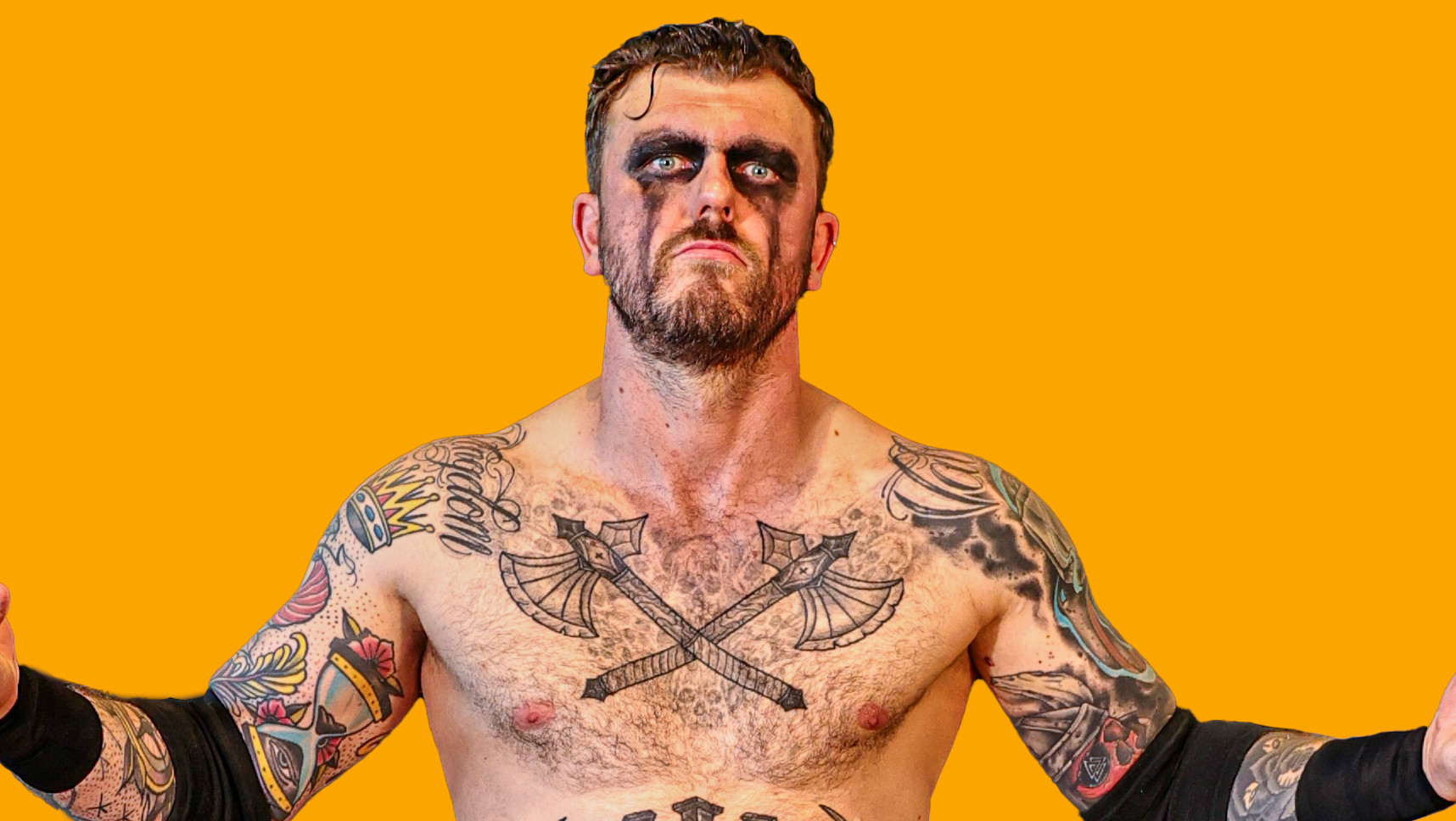
Jackson Shepard is a wrestler, gamer, merch hustler, reluctant social media brand, Mass Effect tragic, and self-described smartarse who insists he is not a veteran despite having been around wrestling for the better part of nine years.
Image credit: @quartzphotography
He grew up in Bendigo, fell in love with wrestling because Eddie Guerrero came out in a lowrider to make the save for Rey Mysterio, moved closer to Melbourne for study, found local wrestling, and eventually realised the thing he had watched since he was ten years old might not be as impossible as it once seemed.
He is shy until the music hits. He is anxious until the character takes over. He does not especially like social media, but understands that in modern wrestling, every performer is also a brand. He has taken breaks, dropped titles, missed wrestling, come back, made merch, sold merch, worked crowds in multiple states, and learned the hard way that in wrestling, everything can change on a dime.
This is a conversation about falling in love with wrestling through a promo segment, the strange geography of the Australian scene, what happens when the passion disappears, why cheap heat still works, and the quiet hope that one day somebody might say they got into wrestling because of Jackson Shepard.
Some wrestlers get hooked by a ladder match. Some by blood. Some by a championship win, a superhero entrance, a giant, a monster, a moonsault, a chair shot, a finisher, a moment so obvious it almost explains itself.
Jackson Shepard got hooked by a promo segment on a go-home episode of SmackDown.
“I got hooked on wrestling at, I want to say, ten years old,” he says. “Growing up, my uncle loved wrestling. Earlier in my life I’d seen wrestling matches and I was like, ‘Oh, this is cool,’ but I didn’t know where to actually watch it.”
Then one day he was channel surfing and found SmackDown.
The episode was the go-home show for No Way Out 2005. Rey Mysterio was on Carlito’s Cabana. The Basham Brothers were talking trash. Rey’s tag partner Rob Van Dam was injured, so the champions wanted to know exactly who Rey thought he was bringing to the title match.
Then Rey named Eddie Guerrero.
“I saw Eddie Guerrero come in with the lowrider,” Shepard says. “I thought that was the coolest fucking thing. That was actually what hooked me. Of all things, a promo segment on a go-home show to a pay-per-view.”
That part matters, because when Shepard talks about wrestling now, he does not talk about it as a collection of moves. He talks about moments. Reactions. The feeling in a room when something works. The way a crowd can be taken from one place to another if the people in the ring know how to steer them.
The lowrider was not just a car. It was a signal. It was the story changing shape in front of him.
And for a ten-year-old kid, that was enough.
The idea that he could actually do it came much later.
Shepard grew up in Bendigo. He had seen independent wrestling when it came through town, but access was limited. The real shift came when he moved closer to Melbourne at around twenty years old while studying sound production.
“That came more when I started going to local shows,” he says. “I grew up in Bendigo, and then when I was about twenty I moved closer to Melbourne. I was studying in Melbourne, so it was easier to do a forty-five minute train ride as opposed to a two-and-a-half-hour train ride.”
Once local wrestling became reachable, everything snowballed.
He started seeing promotions on social media and thought, simply, why not go check it out?
“It was May of 2016. That was the first local show in Melbourne that I went to. Everything snowballed from there.”
He had always loved wrestling. That part never went away. But going to shows in Melbourne changed the scale of the dream. Wrestling was no longer just something that happened on television to people in America. It was happening in front of him, in venues he could get to, performed by people he could meet.
“That was when I was like, ‘Hey, maybe this is a viable thing that I could do.’”
By the end of 2016 he had spoken to Inmate 211 and Terry Shaw, who introduced him to George Julio. George was blunt but encouraging: if Shepard wanted to do it, it would not be easy, but he would train him.
About a month later, Terry made the decision for him.
“He said, ‘Okay, you start Tuesday. Let’s go.’”
The first training session was in 2017.
That was when the dream stopped being theoretical.
Shepard has now been involved in wrestling for around nine years, which is long enough to change how a person watches it.
He still watches as a fan. He still loves the atmosphere. He and his partner even flew to Perth last October to see shows. But the eye is different now. The curtain never fully closes again once you have been behind it.
“It has changed how I watch it,” he says. “Some things are kind of predictable. Other things, it’s like, okay, I know that when that went wrong, that should have been like this. And you can kind of tell when people are calling spots.”
That is not cynicism. It is craft recognition. After enough time in wrestling, the seams become visible. You can still love the suit while noticing the stitching.
Having been around for close to a decade, though, does not mean Shepard is willing to accept a particular label.
“You’re a veteran,” I suggest. “You’re a grizzled vet.”
“No, I’m not,” he says immediately. “I refuse to be called a veteran. I’m not a rookie, but I’m not a vet. I feel like I’m that cool middle ground.”
It is probably the most wrestler answer possible. Experienced enough to know better. Young enough to reject the burden of being seen as old.
One of the lessons Shepard learned early is brutally simple: if something goes wrong, keep moving.
“In training we’ve been told if you miss a spot, don’t go back to it,” he says. “Just move on. It happened. The botch happened. Just move on. Go to the next spot.”
That sounds clean in theory. In practice, it is harder.
He has had matches where he thought one mistake ruined everything, only to get backstage and find out no one else saw it that way. The problem is not always the botch. Sometimes it is what the botch does to your own head after the match is over.
“It can be difficult to not be like, ‘Oh shit, why am I doing this? I constantly fuck this spot up.’”
That feeling became part of why Shepard took an extended hiatus from wrestling a couple of years ago.
“I wasn’t enjoying wrestling,” he says. “I thought everything I did was shit. I was like, I need to get out and I need to get the passion for it back again.”
He stepped away for around six months. Not half in and half out. Away.
“I washed my hands of it.”
At the time, he and Redfield were holding two sets of tag titles, which meant they had to drop them quickly. Shepard felt bad about it, but Redfield told him to do what he needed to do. One promoter, after hearing he was considering time away, told him that whenever he was ready, there would still be a place for him.
That helped.
Then came the show that brought him back.
Redfield and Jason “Krusher” Cole, two people Shepard describes as instrumental in his training, were teaming together one last time. Krusher called Shepard and asked him to come to the show.
Shepard went.
“And just being in that environment, being around other people, it was like, I fucking miss this.”
That night, something clicked. He knew he needed to get back into training as soon as possible. He, Redfield, and Inmate 211 started running private sessions together to shake off the rust.
One thing led to another.
He returned in April last year.
Australia is big in a way that punishes ambition. Every interstate booking is a calculation. Every drive is longer than it looks. Every scene is close enough to recognise but far enough away to have its own habits, rhythms, crowds, and politics.
“We suffer from geography,” I say at one point. “Terminal geography.”
Shepard has wrestled in Victoria, Queensland, and South Australia, and agrees that every state feels different.
“Every crowd is different over there,” he says. “How we interact with the crowd is different.”
In Melbourne, crowd work is common. In some Queensland rooms, he says, there may not be as much of it. But that does not mean one style is better than another. It means each room has to be read.
“It’s all different. Different flavours of ice cream.”
Even within Melbourne, promotion to promotion, the expectation changes. Some crowds want big spots. Some want story. Some want rowdiness. Some want craft. Some want to be yelled at. Some want to cheer the local hero. Some want chaos.
“It’s just finding that balance.”
Can he know the balance before he goes through the curtain?
Not always.
“A lot of it is just chopping and changing on the fly,” he says. “It can be good to go in and watch what the crowd is reacting to. But also it can just be good to go out there and feel it.”
That word “feel” comes up a lot when wrestlers talk about crowds. It is not scientific. It is not measurable in the way a promoter might like. It is instinct, reps, timing, and trust. The crowd tells you what it wants, but not always in plain English.
Shepard remembers working in Adelaide for PWSA, where the crowd was right there with them. He was part of a dark match as a babyface, with a team of Victorians getting the reactions they wanted. Then after the match, they all turned heel. Later in the night, they cemented it by attacking Twisted J and Michael Weaver.
“The crowd was hot for it,” he says. “When the crowd buys into it, it makes things so much better, so much easier.”
And when they do not?
“Just keep trying,” he says. “Eventually you might get them to react. But if it’s not something they’re interested in, sometimes no matter how hard you try, it’s like fighting a losing battle. But always just keep trying, because you never know.”
There is a reason “your town sucks” has survived every supposed evolution of professional wrestling.
Because it works.
In Adelaide, the Victorian group had a very simple point of connection.
“We may have fought,” Shepard remembers, “but there’s one thing that we all have in common. We can get out of this shithole town.”
He knows exactly what that is.
“It’s the cheapest of cheap heat, but it works.”
Wrestling can be complicated. It can be layered and cinematic and full of long-term callbacks and subtle character beats. But sometimes the most useful tool is still the bluntest one in the box. If you are trying to make a room angry, telling them their home is terrible remains almost insultingly effective.
“There’s nothing better than, if working heel, saying one thing just to get a reaction,” Shepard says. “There is a line, obviously. But if you can get the reaction you want, then it works.”
That is the great contradiction of wrestling. It is an art form that can be incredibly sophisticated, but it also has no shame about using the oldest trick in the book if the oldest trick in the book still gets a pop, a boo, or a child pointing angrily from the front row.
After nine years, one of the biggest lessons Shepard has learned is not to believe something is real until it is real.
“I don’t want to sound bitter with this,” he says, “but if you get told one thing, don’t get your hopes up until it actually happens.”
In wrestling, plans change.
A match can change. A finish can change. A title can change. A booking can vanish. A promise can dissolve. Somebody can tell all their mates to come to a show because something big is supposed to happen, and then the thing does not happen.
The lesson he learned from people around him is clearest when it comes to championships.
“Until such a time as you hold it in your hand, it can change on a dime,” he says. “And even then, after that, it can change on a dime. Everything can change on a dime.”
That is the wary lesson.
The more positive one is this: when the good moments happen, do not rush through them.
“Soak it in,” Shepard says. “Enjoy the moment.”
He has been guilty of hurrying before, trying not to go over time, trying to keep things moving, trying to be professional. But some moments deserve to breathe. A debut. A return. A championship win. Something that took years to reach.
“If it’s something you’ve really been excited for, just sit back, soak it in and enjoy it,” he says. “Enjoy the moment and hold on to it.”
A few years ago, after B Squared had their debut match, Shepard asked them how they felt. They were happy. Really happy.
His advice was simple.
“Enjoy this. Enjoy this moment. Soak it in. Remember this feeling.”
He may refuse to be called a veteran, but occasionally the grizzled-vet energy sneaks through anyway.
Away from wrestling, Shepard describes himself as shy, reserved, private, and keen to avoid drama.
In the ring, that changes.
“At a show, if I’m at the merch table or if I’m out in the ring, I’m more outgoing than I actually am outside of shows,” he says. “Believe it or not, I’m actually quite a shy and reserved person.”
At the merch table, he says, he goes into full retail persona. Years of customer service taught him how to put on the voice, smile, engage, and make the interaction work. In the ring, the character takes over in a different way.
“I’m still a smartarse who sometimes says things that he shouldn’t,” he says. “But I’m more outgoing and extroverted when I’m in ring and at the merch table.”
Outside of shows, he is far more introverted. Inside the circle of people he is genuinely close with, he can talk endlessly. Everywhere else, he keeps to himself.
Then the entrance music hits.
“When I hear the opening riff of my entrance music,” he says, “that’s when I go from normal Shep to proper Shep, Jackson Shepard.”
That switch is one of wrestling’s stranger gifts. It gives shy people permission to be loud. It gives anxious people a script without always requiring words. It gives the private person a public mask that somehow tells the truth.
Asked what he thinks about in the ring that most fans would not notice, Shepard pauses.
It is a loaded question. He says as much.
The answer he eventually lands on is not flashy. It is not about a secret technique or hidden signal. It is about location. Not physically, but structurally.
“I like to know exactly where we are in the match,” he says.
Fans see the moves. Wrestlers have to feel the map. Where are we? What have we done? What comes next? How much time is left? What has the crowd been given? What are they still waiting for? If something went wrong, how far have we drifted from the plan? Can we get back without making it obvious?
That is the work people do not see. The match is not just performed. It is navigated.
Shepard thinks about wrestling stories a lot.
Sometimes ideas appear and disappear. Sometimes he writes them down. Sometimes he stores them in his head. A lot of them arrive while he is at his day job, doing the sort of work that gives his brain room to wander.
The difficulty is not having ideas. The difficulty is pitching them.
“For someone with my damn near crippling social anxiety, yes,” he says, when asked if pitching ideas to bookers is hard.
He describes a feud with The Sanctuary at Adrenaline, where he sat down with Nate Clinton and Karn Kruger to map out where they wanted the story to go. How do we get from here to here to here? What are the beats? What can happen in matches? What can happen in promos?
“I tend to hyper-focus on thinking of ideas for stories, for promos, for what we can do in matches,” he says. “I’m lucky that a lot of promoters I work with are open to collaboration.”
Still, bringing an idea to someone can be daunting. You do not always know whether they already have a firm plan. You do not know whether there is space for what you are suggesting. You do not know whether the answer is yes, no, or silence.
The same anxiety shows up around promos.
Shepard believes there is enormous value in being able to cut a good one.
“When I learn how to cut a good promo, I’ll definitely let you know,” he says.
He does not feel entirely comfortable with them, especially live. Pre-recorded promos are different. Those he can take again. Edit. Shape. Fix. With a background in digital media, he enjoys that process. A live microphone is something else.
“Live promos scare the crap out of me.”
He thinks he has cut maybe one good live promo. It came before his hiatus, during a story with Redfield designed to write Shepard off. They had lost their tag titles. Shepard turned heel. On the next show, Redfield called him out.
Shepard took the microphone and explained himself.
Backstage, he was terrified.
“I was shitting bricks,” he says. “I knew exactly what point I needed to get across, what I wanted to say. And the promo popped off. It worked.”
That, he says, was probably his best live promo.
Shepard has a YouTube channel, but it is mostly for streaming game play rather than match footage. He is hesitant to rip matches and upload them himself, even if he appears in them.
“It may have me in it,” he says, “but it’s not just fully my product.”
He knows other people do it. He understands why. He does not think there would necessarily be heat on him for doing it.
But he has lines he does not want to cross.
“I have weird lines that I won’t cross.”
When I suggest that for wrestlers Instagram is essentially the resume, he agrees.
“It’s mostly Instagram, yeah. We just still need to post.”
That is not easy for someone who does not especially like social media.
“This is going to make me sound old as fuck,” he says. “I don’t like social media. I think it’s toxic bullshit a lot of the time. But I understand the need for it, just to promote your brand. Because realistically, at the end of the day, that’s what we are. We’re brands.”
There is the In The Gorilla Position brand. There is the Jackson Shepard brand. There is the performer, the merch, the content, the posts, the videos, the reels, the reminders, the constant proof of life demanded by platforms that reward noise.
“Don’t look in the comments,” he says.
Good advice generally.
For Shepard, a good night in the ring is not just about whether he personally felt good.
It is a set of questions.
Did the crowd react? Did the spots go according to plan? Was everyone happy with how things went? Did the opponent feel good? Did the referee feel good? Did the booker feel good? If there was an agent helping put the match together, were they happy?
“If all those questions are yes,” he says, “then it was a good night at the office.”
If one of them is no, the night shifts. Maybe it is still okay. Maybe it is less than good. Maybe it is, in his words, a complete shit night.
He recently had a match he was grateful would not see the light of day. Everything was rushed. There was no chemistry. Nothing fired on the right cylinders.
No heat to anyone involved, he says. It just happens.
That is wrestling too. Not every match is a hidden classic. Sometimes the timing is wrong, the chemistry is off, the plan does not breathe, the room does not help, and everyone has to walk back through the curtain knowing the thing did not work.
But even bad nights have value.
“You can have utter shit nights at the office,” Shepard says, “but if something doesn’t go according to plan and you learn from it, it can still be good.”
He remembers seeing a philosophy associated with the MCW Academy: you never lose, you either win or you learn.
“That’s basically the way I look at it,” he says. “If you’re not having such a great night, if you learn from it, then it’s not a complete write-off.”
Asked what he wishes was different about wrestling, Shepard does not need long.
“Politics.”
He does not name names. He does not need to.
“There has been politics and stuff that I don’t like,” he says. “I wish we’d all get along for the betterment of the industry. Obviously people are going to butt heads, but we’re all going towards the same goal.”
The issue, for him, is not disagreement. Disagreement is inevitable. Wrestling is full of egos by design. As he puts it, you probably need at least a little ego to get involved in the first place. You are going out in front of people in tight clothes and asking them to look at you.
But ego is one thing. Tearing people down is another.
“What’s the point of trying to tear people down to boost yourself up?” he says. “At the end of the day, you just look like a complete dickhead.”
He has been on the receiving end of it before. People playing politics. People taking opportunities. People trying to make themselves feel bigger by making somebody else smaller.
It may be the nature of the beast sometimes.
He still does not think it needs to be.
“Making it” is an ambiguous phrase in wrestling. Shepard says so immediately.
It could mean money. It could mean demand. It could mean wrestling every week, sometimes multiple times. It could mean people lining up to buy merch. It could mean selling out of merch and needing to restock. It could mean getting signed by WWE, AEW, TNA, MLW, NWA, CMLL, AAA, New Japan, or anywhere else with enough reach to change a career.
For Shepard, the definition comes down to sustainability.
“I define making it as being able to make a sustainable living off professional wrestling,” he says.
Then he adds the important part.
“Having an action figure would help too.”
If a major promotion came calling with serious money, would he take it?
Probably.
“At the end of the day, we’re all whoring ourselves for that paycheck,” he says.
But he would not sign blindly. He would have to think about moving, the schedule, the money, the merch situation, and whether the opportunity actually made sense. The dream matters, but so does the life around it.
“If everything pointed to this being the best possible option, then yes,” he says. “I would happily sign.”
So what does wrestling give him that nothing else does?
Fulfilment.
He knows that sounds generic. He says so before anyone else can.
“It’s got to be the most generic, common, stereotypical answer,” he says. “But the stereotype exists for a reason.”
Wrestling is the thing he wanted to do since he was ten years old. Since Eddie Guerrero came out in the lowrider. Since John Cena won his first WWE Championship. Since all the moments that built the part of him that eventually found a training school and stepped into the ring.
Now he can say he has done some of it.
He has won championships. He has performed in front of big crowds and small crowds. He has wrestled interstate. He has sold merch. He has lived out a version of the thing that once only existed on television.
“It’s the fulfilment of something I’ve wanted to do since I was in school,” he says.
People used to give him grief for wanting it.
His answer now is simple.
“Fuck you. I’m doing it.”
One day, somewhere down the road, Jackson Shepard will hang up his boots.
When that happens, what does he want people to say?
He takes time with this one.
First, he wants people to say he did it. That he made it. That he was successful.
And yes, for the ego, he wants people to say he was good.
“I want people to say, ‘Hey, he was actually really fucking good at what he does.’”
But that is not the answer that really lands.
The answer that lands is what comes next.
“I want people to say, ‘We got into this because of you. We started training because of you.’”
He knows it sounds cheesy. He says that too. But being able to inspire somebody else to take the jump, to follow the dream, to do the scary thing because they saw him do it first and that matters.
“If I had a hand in causing people to be like, ‘Hey, I’m going to take this jump and I’m going to do it,’ then fuck yeah.”
That would mean as much as the merch, the titles, the matches, the bookings, maybe more.
“To have someone look up to me and say, ‘Because of you, I’m doing this,’ that to me is the coolest fucking thing.”
Then he distils it even further.
“Have an impact on someone else’s life.”
That is the legacy.
Not just the match. Not just the promo. Not just the cheap heat, the merch table, the in-house shirts, the interstate drives, the missed spots, the comeback, the social media posts he does not want to make but knows he has to.
The impact.
A kid saw Eddie Guerrero in a lowrider and decided wrestling was the coolest thing in the world.
Maybe one day another kid sees Jackson Shepard and decides the same.
If you've read this far, please consider buying me a coffee! It's really expensive here in Melbourne.
comments powered by Disqus