Brave enough: Eleaine Hope and the dream she refused to leave behind

Eleaine Hope grew up in a small country town in South Australia, watching wrestling on her dad's lap and playing every rough sport she could find. She's a submission specialist, a high flyer, a two-promotion storyteller with a two-year arc still running, and a woman who has stared down the urge to walk away more than once and decided, every single time, that she wasn't done yet. She sat down with In the Gorilla Position to talk about TNA Knockouts, the lumberjack match that made history, the little girls in the crowd who keep her going, and why a small-town country girl living out her craziest dream might be the most important thing she ever does.
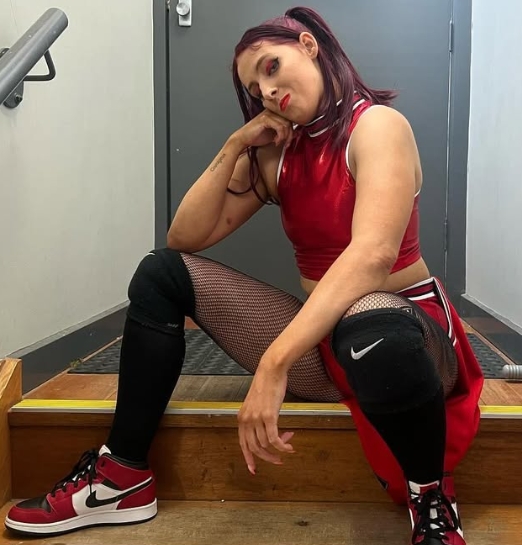
Image credit @mcphotoplay
There’s a tattoo on Eleaine Hope’s body that reads courageux. It is her word for being brave. It is not decoration. It is instruction.
She has needed it. She has needed it on the nights when the matches weren’t coming, when the work felt thankless, when a coach she trusted turned out to be someone she couldn’t defend. She has needed it in every locker room she’s entered as an outsider, in every city she’s travelled to alone, every time she’s climbed to the top rope and trusted the person below her to catch what she was throwing.
She has, so far, always been brave enough.
“No matter what stands in front of me,” she says, “I always need to be brave. There are little girls in the crowd that watch us. And I want to be the one that they can look up to.”
She means this. You can tell she means this because of how she says it. Not as a soundbite, but as something she’s thought about at length, something she carries into the building with her and checks at the door on the way out.
The moment it grabbed her
The story starts, as so many wrestling stories do, with a family member and a television. In Eleaine’s case, it was her dad.
“I’m sitting on his lap, we’re watching wrestling,” she says. “And then I’m playing football with all the boys. I’m playing basketball. Pretty much all the rough sports you can think of.”
She grew up in a small country town in South Australia, the kind of place where, if you weren’t playing sport or at school, you were watching it. During football season, she watched football. The rest of the year, it was wrestling, almost entirely.
But for a long time, the wrestling she was seeing made her uncertain about whether she actually had a future in it. She grew up on the Attitude Era where bras and panties matches, the puppies and the women used primarily as props. It gave her pause.
“I honestly thought at one stage, maybe I should never do wrestling. I’ve seen that type of stuff.”
Then, around 2007 or 2008, someone in her family put on TNA. And everything changed.
“I watched Gail Kim and Awesome Kong. I think it was 2007 actually.” She pauses, recalling the exact feeling. “And I was just there like — oh my God, women are going to wrestle? And that for me was like, no. I can do this.”
She became devoted to the TNA Knockouts. She went back and watched everything. The Beautiful People. ODB. Gail Kim. And, in particular, Taryn Terrell and the Dollhouse which is a reference point she only recently fully understood.
“I saw a clip recently of Taryn Terrell and the Dollhouse. I was like, oh my gosh, this is where I’m getting this from.” She laughs. “I do act like a doll. And then looking at ODB and all that I was like, yeah, this was definitely my tale of why. This is women’s wrestling. I’m all for this.”
The moment that sealed it, the match she still watches at least once a year, came from WWE. AJ Lee versus Kaitlyn at Payback.
“I am a fan of AJ Lee. I study her work all the time. I’ve read the book. And then like, seeing the match and knowing what they went through to make it happen. That match showed me that women’s wrestling could actually go.”
She found her reference points. She found her reasons. Now she needed somewhere to go.
What the family said
She was ten years old the first time she told someone officially what she wanted to be. Her teacher asked the class. She said she wanted to do wrestling.
“Of course, my teacher’s calling up my parents.”
Her parents, it turns out, were not surprised.
“My family were very supportive. My dad’s the one who got me into wrestling. He knew I was not going to be easily talked out of anything.” She grins. “My parents are always like, she’s going to do it. We’re not going to stop her.”
The family culture helps. Her mother comes to nearly every show. She is known in the locker rooms at Mayhem as Mumma Hope. Her dad filmed gymnastics competitions when she was young. He calledn them tape studies and that obsession with watching yourself back, with learning from footage, is something Eleaine has inherited entirely.
Friends were a different matter. She was nervous, she says, about telling people outside the family. The way she eventually told her best friend from high school was by taking her to a show in South Australia first.
“I was like, and she’s like, what? I’m like, yeah, I suppose.” She laughs. “And then at my work, I had to give a fun fact. And I was like, the only fact I have is I’m a professional wrestler. And they were like, what?”
The best version of that story involves a coworker who one day looked across the desk at her and said: I know you. I saw you at the wrestling.
“I was like, you were at this show. And you did this. And I’m like, oh, thanks, man. It’s so cool.”
What training taught her
Eleaine started at MCW Academy in 2018, one of the first girls to join when it opened. The first year was hard in ways that went beyond the physical.
“I was going through some pretty heavy things at the time. Some heavy personal stuff. I was always there. I was always helping out, always training, trying to get better.” She pauses. “And I was getting better and better and better, but there was never any end goal. It felt like a stalemate for such a long time.”
Then COVID hit. The shows stopped. The escape route closed.
“There goes my escape with everything.”
And then came Speaking Out with the wave of abuse allegations that swept through wrestling in 2020 and named, among others, one of her coaches. Someone who had trained her. Someone who had seen her at her lowest.
“I was like, this person trained me. I’ve spoken to this person about various things. I didn’t think someone like that could do it.” She is measured about this, but you can hear what it cost her. “Seeing people who I was inspired by some of them I had met, which genuinely hurt, I was like, oh, my gosh, I’ve had interactions with these people. I’ve gotten to the point where I can call them colleagues. And they were very lovely. And then.”
The sentence doesn’t finish. It doesn’t need to.
“I think that was a breaking point for me. Where I was like, I can’t continue if we’re going to. But then I was like, no. We’re getting rid of these types of people. That’s what we need to do.”
She stayed. But the doubts weren’t finished with her yet.
She describes a night at Relentless, probably around October of the first year, when everything caught up with her at once. She’d been training hard, doing performance camps, showing up to every show, doing everything she’d been told. And still no match.
“I was like, am I not meant to do this? I was really doubting myself.”
What pulled her back was people. Jake, her trainer, at a PT session the following Monday. Her fiancé Lockie. The conversations that reminded her what she was doing and why.
“He was like, your time’s gonna come. Your time will come.”
She listened. She stayed. Her time came.
What wrestling taught her about herself
She was shy when she started. Very much in a bubble. Someone who said yes when she should have said no, who sought approval because approval felt like safety.
“I was like, if I say yes, great, I’m in the good books.”
Wrestling, she says, broke that open. Not gently.
“I’ve actually learned who I am. Being able to be like, oh, I can do this. Oh, this is what my limit is. I’ve learned to say no. Because if I’m not comfortable with something, I say no.”
She’s clear that this isn’t just about the ring. “Me in the ring is one side of me, but there are elements I can take of me in the ring to everyday life. The confidence. Knowing when it’s appropriate to open my mouth. And sometimes that can get you in trouble.”
Wrestling gave her, she says, a place to discover those edges. Her limits. Her abilities. The parts of herself that were always there but needed somewhere to be tested.
“Really, wrestling’s taught me who I am. Like I can take what you see in the ring and I bring her to me everywhere I go. Because in a way, she’s a part of me.”
She pauses, then adds something that is half joke and half absolutely serious: “I mean, it is great therapy at times. I’ve had a bad day at work. I’m just going to go and kick and stretch people.”
The character: Brain, speed, and a submission game
Eleaine is not, by her own cheerful admission, the biggest person in the room. She is not going to out-muscle anyone. This is not a problem. It is a strategy.
“I’m not the strongest. That’s why I’m always like, I know my strength. And that’s speed, I have my brain, and then my flexibility. If I can’t outpower them, I need to outsmart them.”
This is why she loves submissions. This is why she worked, even before her first match, to learn the abdominal stretch, not just as a hold, but as a piece of vocabulary, a statement about what kind of wrestler she intended to be.
“It was one of the first things I said when I was getting ready for my first match. I need to learn this. It was tough, and I learned it.”
Her submission game is something she thinks about as a technical art form. She prefers twenty minutes of chain wrestling to a twenty-minute high-spot showcase. Not because she can’t fly (she absolutely can; the top-rope dive in the lumberjack match is evidence enough of that) but because she finds the chess match more compelling.
“I would be more fascinated with twenty minutes of chain wrestling. Out-wrestling people is what inspires me.”
She names her influences without hesitation: William Regal. Zack Sabre Jr. The British technical tradition. She watches, studies, and takes notes. Her father’s habit of tape study, applied to the craft she loves.
The inter-gender matches that make up a significant portion of her career don’t faze her, either philosophically or practically.
“I don’t see inter-gender wrestling as inter-gender wrestling. I just see it as wrestling. Because at the end of the day, I’m going out to the crowd, I’m being myself.” She adds a practical note: “And as long as you sell the move, a sixty-kilo woman beating up a ninety-kilo man is perfectly valid. Because you’re there to suspend disbelief.”
The match that was also HERstory
Ask Eleaine Hope about her best night in the ring, and she will tell you about Perth.
It was her first interstate wrestling trip. Her first ever title match. Her first ever lumberjack match and, as she found out on the day, the first women’s lumberjack match in Australian wrestling history.
“I just remember being like, oh, so we’re making history. Oh no, we’re making herstory.”
The match was against Harli Hyde, who is Perth-based and has since become someone Eleaine genuinely wants to share a ring with again. It was originally supposed to be a triple threat with herself, Hyde, and Layla Divine but Divine had to pull out. Eleaine and Hyde made it work.
“I remember being like, all right, let’s go crazy with this match. We need to go crazy with it.”
She got to train at EPW during the week beforehand. She met a locker room full of people who, she says, were unfailingly supportive. Hayden Zenith “great guy in Perth” gave her tips backstage about the abdominal stretch, demonstrating adjustments she hadn’t considered.
“He didn’t have to do that. But he did. And I was like, oh, this is a really fun locker room. I love this type of environment.”
The promoter, Sharkey, was happy with the match. Lockie was there, in his own title match that same night, which gave Eleaine what she describes as her rock for a day that could have been very overwhelming very quickly.
And then there was the show’s name.
“At the time, I had just gone to the Taylor Swift Eras tour. It was like everything lining up for a great night.” She laughs. “I couldn’t think of a better name for a show to have me on than Cool Summer, knowing how big a Swifty I am.”
She watched the match back afterwards. Saw how the crowd, a crowd that had never seen her before, got invested. Saw herself finding ways to draw them in despite being the visiting villain.
“Getting them on my side was just really captivating. Having that challenge really pushed me. And I was grateful for it, because it was a great lesson to have.”
Why she keeps going
The honest answer, she says, is the community. The wrestlers, the fans, the whole ecosystem of people who show up because they love it, not because they have to.
But there’s something more specific underneath that. Something she circles back to more than once.
The little girls in the crowd.
“Seeing them is what really keeps me going no matter what. Just seeing how much work we put in and how much we’re dedicating to it, just to see the reactions of little girls. Because at the end of the day, they love wrestling too.”
She describes a girl she’s watched grow up at shows. A kid who announced to Eleaine, with the absolute certainty of children, that she was going to be a wrestler.
“And I told her, you will be. You’re going to be a wrestler. I’m going to make sure that happens, because we need it.”
She talks about her niece, who has outfits based on her favourite wrestlers, who she is trying to source a pair of Jordans for so she can have a “true Eleaine Hope outfit.” She describes what it means to be a female wrestler in a predominantly male industry right now when little girls are coming to shows with their dads and their brothers and seeing women in the ring and thinking, for the first time, that there’s a version of this that includes them.
“There’s now a rise of young girls who are falling in love with this. They’ll see a female wrestler and go, I want to do that. Like when I was little.”
She is, she knows, one of the people making that possible. It’s a responsibility she takes seriously. The tattoo reminds her.
The story still running
Of everything she has done in wrestling so far, the thing she is most proud of is a story.
It’s been running for nearly two years at Alpha. It started with her searching for a tag team partner. It evolved through betrayal, realignment, emotional lows, and moments she describes with the restraint of someone who doesn’t want to spoil the ending because the ending isn’t written yet.
“I am so happy where we’ve gotten into. We’ve had some hiccups along the way. But I think it’s been one of my proudest achievements in wrestling, this story of how far I’ve gone with it and knowing I’ve still got a bit to go with it.”
This is, perhaps, the clearest sign of what Eleaine Hope actually is: not just a wrestler who has matches, but a storyteller who happens to express herself in a wrestling ring.
“Wrestling is all about stories. And every time I have the chance to tell one, I find it so rewarding.”
She wants to go everywhere. She has done Melbourne, Perth, Sydney. She wants Queensland. She wants the ACT. She wants South Australia, because going home would mean something different to her than anywhere else. She wants Tasmania. She wants, eventually, the UK because her technical inspirations are largely British, and she wants to go to where that tradition lives and test herself against it.
The world keeps getting bigger. The dream keeps extending its edges.
What she’d tell her younger self
She doesn’t have to think long about this one.
“I would go back to 2015 me, who had wrestling as an escape. Growing up in a small country town in South Australia, trust me, I knew about needing an escape.”
She describes that version of herself: playing sport, at school, watching wrestling or football. Wrestling almost all year round. A girl who already knew, deep down, that this was the direction she was heading, but couldn’t quite believe it was really possible.
“I would look at my younger self and be like: Hey, I know this is going to sound daunting. But you’re going to do it. That’s the thing you need to realise. You’re going to do it. Yes, there’s going to be bumps along the way. There’s going to be a few rolls. But at the end of the day, you’re going to achieve it. Just embrace everything that happens on the journey. You’re going to learn from it. You’re going to pick yourself up and become the best version of yourself because of your love for wrestling and what it brings to you.”
She pauses, and then says the thing that makes you understand everything that’s come before it:
“That version of me would say I was insane for doing professional wrestling. And that me is wrong.”
What she wants people to say
The final question lands, and she laughs, and then she gets quiet, and then she says she’d like to die in the ring if possible, which prompts an immediate text from her fiancé Lockie that reads not before the wedding, and the conversation briefly derails into a very funny exchange about bubbles and inevitability.
But underneath the joke is the real answer, and she gets there.
“I want everyone to remember the strong, brave, confident woman in the ring that they saw. Like, no matter what, I made people happy. I made them feel invested.”
She thinks about it more.
“I want people to know that I’ve made myself proud. That I’m living a dream. The fact that I can say I’ve lived out my dream and done it to the best of my ability, that’s what I want people to remember. That a small-town country girl from South Australia was able to live out one of her craziest dreams. That anything is possible.”
She smiles, and the thing that’s been running underneath this whole conversation comes up to the surface one last time.
“So she can do it. Anyone can accomplish their dreams.”
The tattoo says brave. She has not stopped proving it.
Eleaine Hope competes across multiple promotions in Victoria and interstate. You can follow her on Instagram and find her story on YouTube. She is, she confirms, definitely going to find a way to get to Tasmania.
Check out Eleaine Hope on:
Linktree
If you've read this far, please consider buying me a coffee! It's really expensive here in Melbourne.
comments powered by Disqus