New Horizon Pro Wrestling
Inside the mind of Korvus: Building a villain, one Perth show at a time


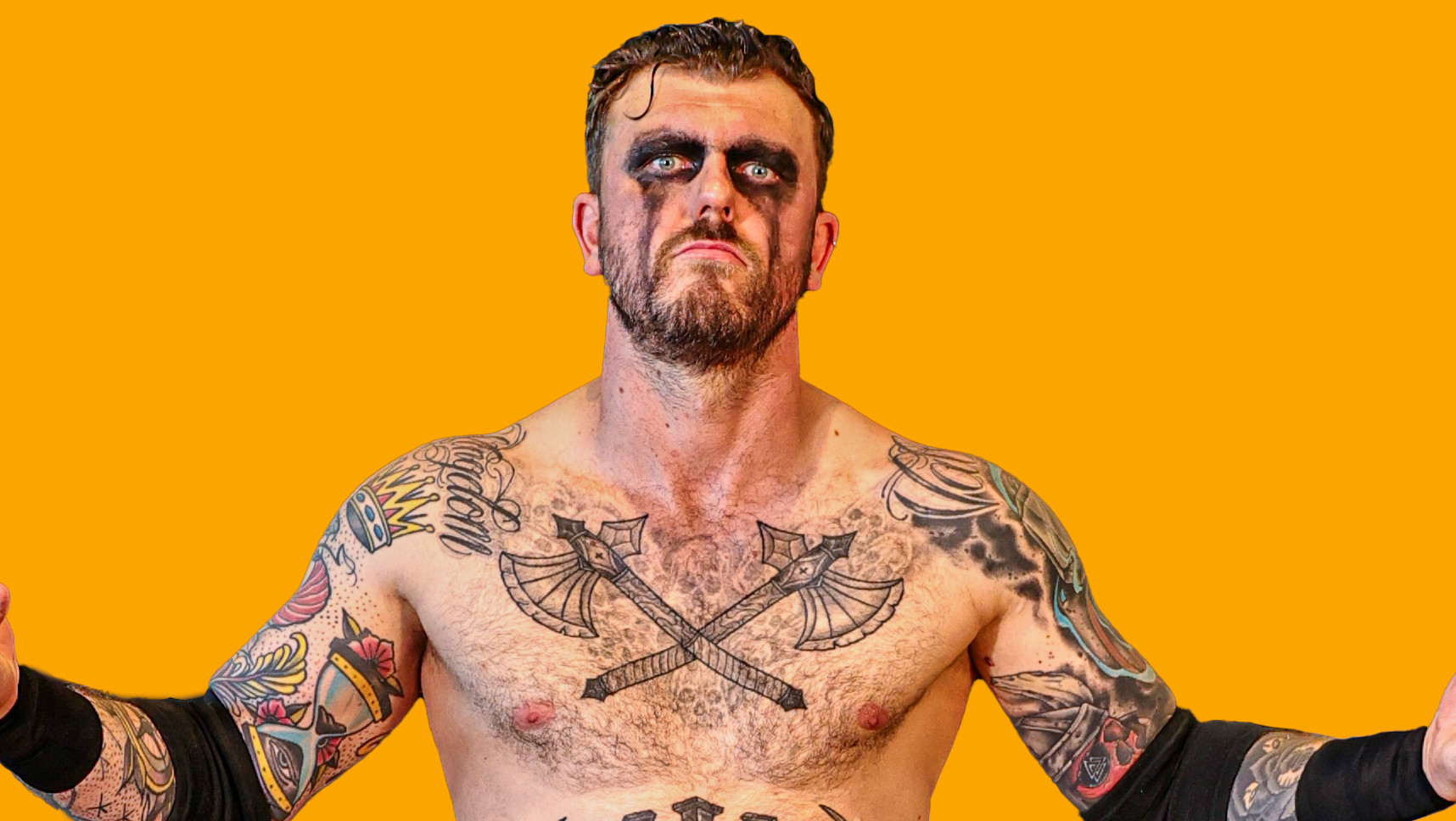
Twenty-three years in. A wrestling veteran, a coach by instinct. He started in Adelaide when the scene was barely a scene, trained under a man who came out of retirement just to give a handful of backyard kids a fighting chance, and has spent two decades quietly becoming one of the most respected figures in Australian wrestling. He’s wrestled in Japan, signed a major league contract, and turned down opportunities most wrestlers would crawl over broken glass for and all to stay true to something he believes in. Damian Slater isn’t chasing anything. He’s building something.
You’ve been in wrestling for 23 years. Where did it start?
It wasn’t always about being a wrestler. It was just an obsession with wrestling. That happened in 1999, smack in the middle of the Attitude Era, when wrestling was the most mainstream pop culture thing there was. Primary school kids were consumed by it.
But I was into everything else. Sports from as long as I can remember: cricket, soccer, rugby, basketball. I played everything. Wrestling was actually the last thing I picked up.
I heard about it constantly but never really entertained it until I was at a birthday sleepover at a friend’s place when I was eleven. It got to midnight and WWF Warzone was on Channel 9 on a six months delay, late at night. We flicked it on and I was just blown away. The Undertaker was one of my first favourites. I was a big horror fan at that age, I have no idea why I was watching horror movies at eleven, but I was and those supernatural characters just sucked me right in.
And then there was the ongoing nature of it. It wasn’t a movie you watched and put away. This was a weekly show and you were always waiting to see what happened next. That just hooked me completely. By the time I was fifteen all the other sports had dropped away. Wrestling was all there was.
How did you get from fan to training in Adelaide?
The Adelaide scene had been largely a black hole until about 1999. That’s when Col Dervany, my coach, rest in peace, he passed away a few years back and came out of retirement to train a group of backyard wrestlers who were keen on doing it properly. Someone footed the cost and basically said, old man, can you please come back and train these kids?
One of them was Hartley Jackson, who is now in New Japan Pro Wrestling. Col trained that group from scratch.
A little side story: one of the wrestlers he trained in those early years was a rugby player. And my dad was his coach. My dad just said, you like wrestling, one of my players is doing it now, let’s go watch. I saw it and I was hooked.
By the time I started training three years into the promotion’s existence, the roster was tiny. The Perth scene had only started up maybe a year before I began. They’d actually all flown to Adelaide, trained full-time with Col for a month, and brought it back to Perth. Similar story to ours with backyard wrestlers putting on shows in kickboxing rings, no proper training, figuring it out from scratch.
It was very easy to get on shows because rosters were limited. But it was very hard to get knowledge. You learned the fundamentals really well because Col was phenomenal for that and very old-school.
But to get wider perspectives, you had to do it yourself. Find a contact, travel alone, pay all the money, hope something happened.
You mentioned going overseas early. Where did you go and who did you train with?
My first few months in America I was with TJ Perkins, who has been in every top promotion in the world. Me and him trained one-on-one for three months, every day, for hours. To me, he’s one of the most incredible coaches I’ve ever encountered. He’s not someone people would know as a coach but he’s never run a school, just clinics and seminars and I had access to him through those months and it changed everything.
Then I trained with Rocky Romero. A couple of years later I went to Japan and trained with Ikuto Hidaka who’s for me, the most underrated junior heavyweight ever produced in Japan. I trained under lucha coaches. I tried to get to as many different people as possible.
I was always a student of the game. I wanted to know everything about everything.
And I’d just pick the best parts, the things that resonated with me, and bring them back. I’ve never been someone who just rests on how we train because that’s how we’ve always trained. I always ask why.
When did the coaching side start?
In 2005 Hartley Jackson decided to start his own dojo which in time became the Wrestle Rampage dojo. He had a vision: the discipline and work ethic of the Japanese pro wrestling systems, wrestling approached as a sport. He went to New Japan, trained with Antonio Inoki, and brought that back.
I believed in his vision so I jumped in with him.
There were only six or eight of us training there. Being one of the more tenured members, even though I was only three or four years in, and having just started going overseas, I was trusted to assist. Running warmups, running drills. And it just grew from there.
In the real world, I’ve been a teacher for twelve years. That helps because you know what to look for, you know how people learn differently, you know when to push and when to ease off. And I’ve always been curious about what the best approach actually is. Not what we’ve always done. What actually works.
You moved to Perth eventually. What’s EPW been for you?
EPW are twenty-five years in the game this year. When I moved to Perth at thirty I’d spent three decades in Adelaide. EPW is where I’m based now and locally it’s the only company I work for. That’s a choice. There are others I could work for. But I’m only wrestling maybe once a month at this point, which suits me. I can scratch the itch and then go back to the rest of my life.
What drew you to only working for EPW in Perth?
There are lots of reasons. I don’t want to get into all of them. But mostly it comes down to what they stand for and what they’ve built. The companies and schools in Australia that have lasted the test of time, EPW, Riot City Wrestling, Wrestle Rampage, the Sydney and Melbourne promotions have all lasted because it’s a community. It’s the wrestlers themselves who are holding things up. Setting up rings, doing promotion, caring about the product.
There’s something different about that compared to when someone comes along and says, here’s some money, wrestle for me.
You’ve seen the Australian scene evolve over twenty-three years. How do you see it now?
I’ll probably sound arrogant here, but I’ll say it anyway, I don’t think anyone can argue that we have the best scene in the world. Look at all the shows running around Australia, compare the number of wrestlers to the population, and compare that to what’s happening in America and the UK. We absolutely trump them.
The reason? Partly it’s the DIY mentality.
No one’s coming to help us. If we’re not making it happen, no one is.
The promotions that have stuck around are the ones where wrestlers genuinely care. And partly it’s because we haven’t been raided.
The UK got completely raided when the major companies came and signed everyone. They had to almost start from scratch. The American indie scene isn’t what it was twenty years ago: Ring of Honor was killing it everywhere, PWG was selling out shows. Those companies are largely gone because the talent has been taken. We still have our best wrestlers here. They’re not able to get out easily because of visas, flights, cost. Which is heartbreaking for them individually, but it means they stay and build the product and bring up the next generation.
Some of those wrestlers should have been on Monday Night Raw this week. That’s not an exaggeration.
I believe in this crew.
Do you watch wrestling as a fan or purely as an analyst at this point?
I can’t help but analyse everything. That’s been the case for a long time. If you’re switched on as a wrestler, you should be watching crowds when you watch shows and seeing what’s working, what’s getting reactions, what isn’t. But I still try to be a fan when I can.
When I get to see a live show, that’s where I get to be a fan again. It doesn’t happen much but when it does it brings me right back. I’ve seen some of the worst pro wrestling shows in history live, and loved them in the moment. There’s a lot to be said for the tribe. Wrestling is just another expression of that.
Can you make a living wrestling in Australia?
No. Honestly, no.
Proximity makes it basically impossible. If you’re on the East Coast you can drive between cities from Sydney to Newcastle, Melbourne to Brisbane if you put a lot of kilometres in and maybe work locally once or twice a week. But most companies aren’t paying enough to substantially make money. You might earn enough to buy food on the way home and put a quarter of a tank of petrol in. It’s hard.
You have to find multiple streams. Merchandise. Seminars. Monetising social media. It’s not much but you get something month to month. Negotiating smarter with promoters. A bit of everything.
That frustration is actually part of why I started worldbeaterwrestling.com. You spend so much of your life committing to wrestling, putting things aside like work, maybe careers and I thought there has to be a way to make at least a bit of pocket money from all that knowledge. Three years in now, hundreds of members from around the world, members who have gone on to sign with AEW, WWE, NXT. Which has been incredible to watch from afar.
Will we ever get to a point where someone can make a full-time living in Australian wrestling? I don’t think so. Proximity is just the reality. But will we get to a point where wrestlers are paid what they’re worth, where it’s at least a meaningful part-time income? Yes, I think we’ll get there. We’re nowhere near what it was ten years ago, where wrestlers were barely valued at all and coaches weren’t paid. That’s changed significantly. Still a long way to go, but it’s moving.
You mentioned the online coaching. How did that come about?
Same frustration, really. I spent so much time accumulating knowledge from around the world, and I thought, “there are people out there who don’t have access to great coaching”, whether that’s because they’re in Southeast Asia where wrestling is only just starting, or they’re in a smaller Australian city with limited options. What I do online isn’t primarily physical because you’re right, that’s hard to translate remotely. It’s everything else.
Psychology breakdowns. Tape studies, why did this match work, why didn’t this one. Ring IQ. Blogs every week. Video tutorials. Match feedback. I keep a very small mentorship group,fifteen maximum, and when those spots fill that’s it. I close it off and work with them closely. Conference calls, feedback, collaboration.
No one else is really doing what I’m doing online right now. Which makes me more motivated, honestly. Uncharted territory always does.
What do you wish was different about the business?
For a long time I wanted wrestling in Australia to be approached more professionally. And it wasn’t. Wrestlers weren’t getting paid, coaches weren’t paid, and no one rocked the boat because when the person next to you isn’t getting paid and you want to be where they are, well, you just take the hot dog and the handshake and smile.
That started to change when people went overseas and realised, hold on, the UK pays me a few hundred dollars for a match. Why am I getting $20 in Australia for a show three times the size? Once people started approaching it with a business mindset, things shifted. Still a long way to go, but nowhere near what it was.
Now, and I’ll say this carefully because I don’t want to sound like a drill sergeant,
I’d like to see a bit more old-school grit come back in some places.
When I came up, the expectation was clear: train multiple times a week or you don’t get booked. You come to the show, you set up the ring. You take it down. The next day you set it back up at training. If you didn’t, the door was right there, no hard feelings.
In some places that expectation has softened to the point where a couple of people are doing all the work and a lot of others aren’t. And you can see it in the ring with less discipline, less passion, less of a culture being driven. The best companies in Australia have people who drive that culture really well. But it’s something I’ve noticed creeping in, and I think it’s worth naming.
How do you spot someone who’s going to make it?
You can’t always. Not even just in wrestling; that’s everything. Wrestling especially though is such a demanding undertaking. People don’t understand until they actually do it properly. A large majority of people who come to an open day or a tryout make the decision for themselves when they realise this is not what they thought it would be. We don’t have to say anything. They just go, “this isn’t for me”. And that’s fine.
But there are people who genuinely can’t get there no matter how much they want it. Whether it’s discipline, work ethic, ring IQ and ring IQ is real and it matters. We are essentially stunt performers working improvised high-risk theatre in front of a live crowd with no safety net and no script. The coordination, the conditioning, the mental understanding of how to get a reaction from a crowd in real time not everyone is built for that.
What matters more? The physical or the psychological?
In the early stages, fundamentals and safety above everything. We don’t want people hurting themselves or others. But to actually move up?
Everything comes back to the crowd. You can wrestle a fundamentally perfect match and if the crowd isn’t responding, you haven’t done your job.
There have been world champions, people on television, who couldn’t forward roll correctly. Couldn’t do the bare fundamentals. But they could talk people into the building. They could build a persona that resonated. To me, that’s everything. You don’t need a perfect backwards roll to do that.
If you can do all of it: the physical, the psychology, the character, then you’ve got a very high ceiling. But that one weakness can be the thing that closes a door. If a promoter thinks your promos are beyond saving, that’s it. So be a specialist in what you’re best at, but be good enough at everything to get through the door.
You’ve hit burnout over twenty-three years. How do you keep coming back?
Every year I burn out at some point. But I find it very easy to find something that keeps me in it, and it’s not always the wrestling itself.
Sometimes I genuinely can’t be bothered wrestling but I love the people backstage. So I go for the social side and take the expectation off and just enjoy myself. Other times I don’t want to see anyone but the creative side is firing and I’ve got ideas for a match I’m excited about. And then there’s coaching and producing other people’s matches, helping talent, being a booker on and off.
I’ve probably quit booking six or seven times. Can’t do this anymore. Then two years later someone asks and I go, “alright, fine”.
I just duck in and out based on my interests and level of burnout at the time. I think the problem for a lot of people is having all their eggs in one basket. When all your time, energy, and identity goes into one thing, that’s where you start to crack. I’ve never done that. I’ve always had too many things going on.
Have you made it?
Well beyond what I ever imagined. When I first started training at fifteen, my goal was to have one match and retire. I got to that first show and thought that was really fun, I want another one. And it just kept going from there. Another city. Another country. A WWE tryout. I did sign a major league contract and had three months, one match. So technically I did it. Did I go on and have a main roster career? No. Does it take up any of my sleep? No.
I think making it is so subjective. For me, there’s a phrase I keep coming back to:
leave the place better than you found it. And I can confidently say I’ve done that. Many places. Many different parts of wrestling. I’m very proud of what I’ve built.
If your daughters came to you at fifteen and said they wanted to wrestle what would you say?
I’d train them myself. Happily.
Wrestling has given me every great thing I have. My wife of ten years. My kids. The reason I live in Perth. The career I’ve had. Everything comes back to wrestling. Ninety-eight percent positive. So yeah. If they want in, the door is open.
I will micromanage everything they do, but the door is open.
Last question. What do you want people to say about Damian Slater when it’s all over?
I think about someone like Davis Storm, who has been one of my biggest mentors since the beginning. He retired close to a year ago and when people talk about him, before they say anything about his wrestling, they say he was a good person. Unanimously. And his wrestling was phenomenal. He was probably the most underrated wrestler I’ve ever seen, still killing it at forty-five, forty-six, not taking a backward step.
But everyone talks about him as a human being first.
So I don’t want to say I want to be known as a nice person because that’s too wishy-washy. I want to be known as someone who helped out as many people as they could. Who was genuinely happy to give their knowledge, to give their time, to give feedback to someone who needed it. Someone who was never too selfish in the ring.
Honestly, some of the most rewarding moments I’ve had in wrestling are when I’ve gone to a show injured, couldn’t compete, and just sat backstage helping produce matches and giving talent feedback. Those nights have been some of the most fun I’ve ever had.
If that’s what they remember. That’ll do me.
Damian Slater has been a professional wrestler since 2002. He is a coach and co-operator at Explosive Pro Wrestling in Perth, Western Australia, and mentors wrestlers internationally through his platform at worldbeaterwrestling.com.
If you've read this far, please consider buying me a coffee! It's really expensive here in Melbourne.
comments powered by Disqus