New Horizon Pro Wrestling
Inside the mind of Korvus: Building a villain, one Perth show at a time

Ben Barnett started wrestling at 26, late by anyone's measure, after years of saying maybe one day. Two years in, he's running two characters, main eventing his home promotion, and still carrying a black armband in his bag for the coach who believed in him before he believed in himself. This is the story of the Gambler, the bet he made on himself, and why the dice always get rolled again.
Image credit: @themar00481
Ben Barnett is from Melbourne and has been wrestling for two years. This is long enough to have had collarbone surgery, invented a character, reinvented a character, main evented his home promotion, dumped a bag of dice on a man, and rolled a Singapore cane like a casino table. He is the Gambler. He is also, in a different shirt, Mr. All Night Rod Long. He sat down with In the Gorilla Position to talk about Jeff Hardy in 2008, what Razor Ramon looks like at the TAB in 2025, the woman who believed in him before he believed in himself, and why journalism and wrestling turn out to be the same job.
There is a spot in the middle of the Casino Brawl, the main event of Mayhem Pro’s recent big show, the blow-off to six months of storyline where Ben Barnett rolls a pair of dice on the canvas.
He doesn’t like the result. He rolls again. He gives his opponent four punches, the number matching the dice. Then he picks up the Singapore cane, rolls one more time, gets a number he’s happier with, and delivers three whacks across the back. The crowd, who have had the logic of this fully explained to them by the character’s behaviour across half a year of appearances, completely understand what they’re watching.
It sounds like comedy. In the ring, at that moment, it isn’t. Not entirely. It’s something more interesting: character work so thoroughly developed that the gimmick has created its own rules, and the audience is in on them.
“It fits the character,” he says simply. “And it’s using the weaponry we’ve already introduced. It makes sense.”
This is the Gambler, Ben Barnett: erratic, expressive, committed to the bit in a way that tips between comedy and genuine heat, and always, always backing himself even when the dice say he probably shouldn’t.
Like most kids of the day he didn’t grow up with pay TV. Wrestling was something he encountered in snatches, in motel rooms on family holidays, smashing his brother with pillows like they were steel chairs, video games, at the edges of popular culture. It was always there, just never quite close enough to grab.
Then, in early 2008, his parents got Foxtel to watch the Beijing Games. They barely saw any of it.
“It was always me watching wrestling.”
The first episode of Raw he caught was the go-home show before Judgment Day. He was twelve. The Undertaker immediately became his guy until Vickie Guerrero banished the Undertaker from SmackDown, and the twelve-year-old on the couch felt the specific devastation of a wrestling fan who has had their favourite thing taken away.
“I was shattered. I was like, this is the one reason I got into it, and I’m not watching wrestling anymore. This is my last episode.”
Then they showed the video package of the Falls Count Anywhere match between Jeff Hardy and Umaga. Swanton Bomb off the back of an eighteen-wheeler.
“That was the moment. I became a massive Jeff Hardy fan. I think I was a bigger Jeff Hardy fan than a wrestling fan at that point. Jeff Hardy in 2008, he talks about being bigger than Obama. Posters. Action figures. All of it.”
He grew, as wrestling fans do. Came to appreciate the heels. Became a serious Edge guy. Was captivated by Bray Wyatt’s ability to construct something from almost nothing. The mythology of it, the way character could make a story feel genuinely dangerous. Then the Network launched, and he went back and consumed the years he’d missed: the Attitude Era, the Ruthless Aggression Era, the New Generation. Kevin Nash. Razor Ramon.
That last name planted something.
It had always been in the back of his mind that he wanted to do it. His parents talked him out of pursuing it seriously through his teenage years. At eighteen he started looking at schools and kept saying maybe one day. Mid-2020, locked down and running out of reasons to delay, he finally stopped saying maybe.
“I didn’t want to wake up one day and go, if only I’d tried that.”
He was 6'4", had played basketball and footy growing up, rowed in high school. His mum was a high-level rower for the state of Victoria! Ben had always balanced sport with drama and media. Wrestling, when he eventually got to it, felt like the logical destination for all of it.
He started training at the MCW Academy. The first time he stepped through the ropes, the middle of his back touched a turnbuckle and something happened.
“It felt like home. Like, this is right. I was meant to do this.”
He trained for just over twelve months. Then, playing in an ice hockey game, he broke his collarbone. Full fracture. Surgery. Plates and screws, which he still has. He woke up in the hospital room and his parents asked him whether he’d go back to ice hockey.
“Maybe not.”
Would he go back to wrestling?
“Yeah. That’s, you know … safer.”
He laughs at the logic of this, but he means it. The collarbone happened because someone got white line fever. In wrestling, you make a deliberate agreement to take care of each other. He finds the distinction meaningful.
He was out for the surgery in October. By January he was back. And while he was on the shelf, with nothing to do but watch, Kevin Nash led him back to Razor Ramon, and a question started forming.
What would Razor Ramon look like in 2025, in Australia?
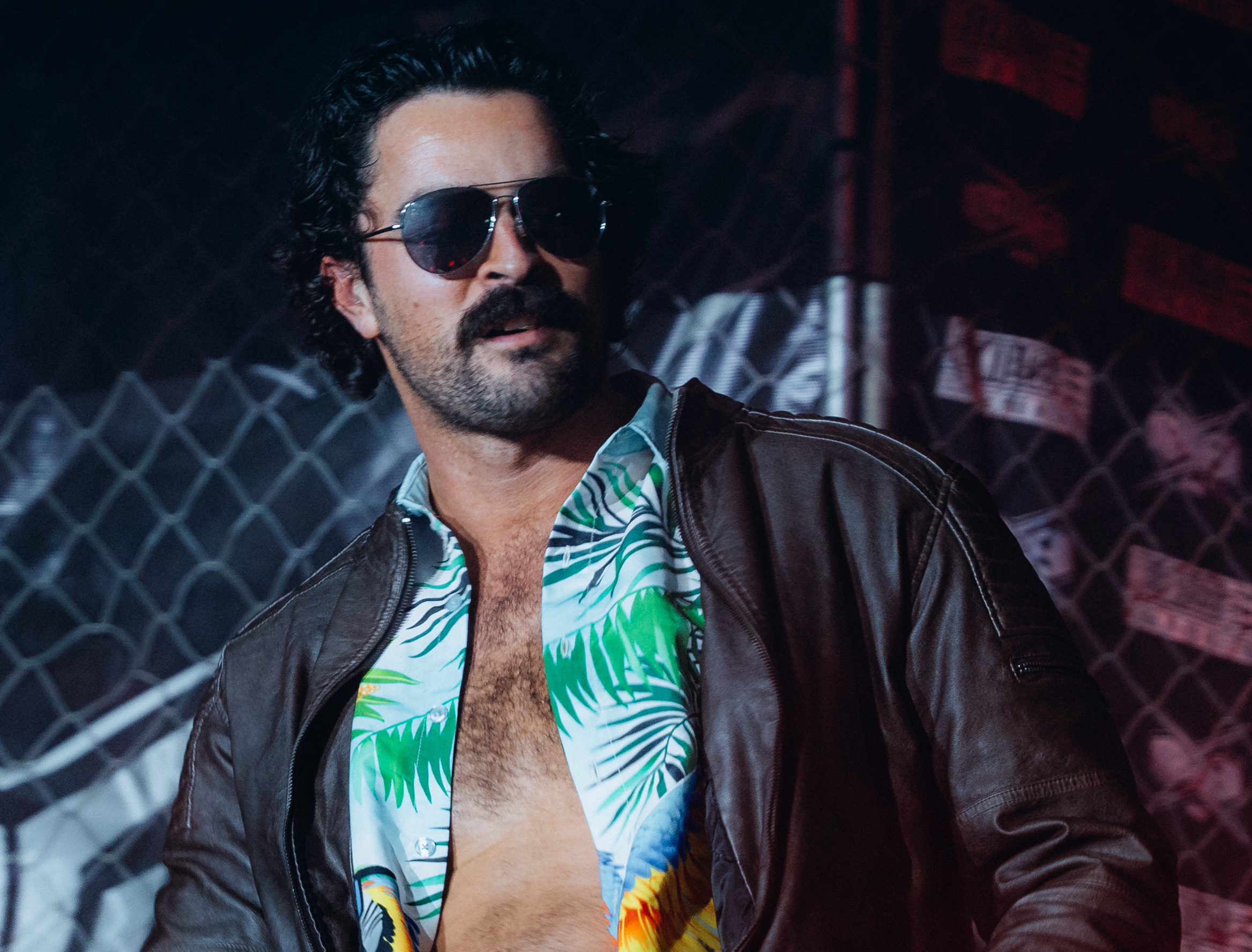
“Some sort of Hawaiian shirt pokies fiend at the TAB.”
The Gambler had his first appearance in January. The character that had been sitting quietly in his head for years had found its home.
Before the Gambler could be anything, there was someone who believed he would be something.
Miami was a coach at the MCW Academy. She passed away from breast cancer in 2023, and her death was part of what led to the Academy’s closure. Ben pauses noticeably when he brings her up, near the end of the conversation, in response to the question about whether there’s anything else he’d like to say.
“One thing I really noticed in the weeks after her passing, when I was talking to other students at the school, was that she believed in all of us before any of us believed in ourselves.”
After her passing, MCW held a show. All the talent, all the crew were given a black armband to wear on the night.
“I still carry mine in my wrestling bag. Everywhere.”
He pauses.
“It’s that self-belief. And it’s funny that how I got it from the Gambler. Now I get it from myself. But yeah, I think maybe if I’d had that belief earlier, I would have started earlier. But you can’t regret the path that you’ve taken.”
She was, he adds quietly, not only an exceptional coach but a genuinely talented wrestler. A wonderful human being.
The armband stays in the bag. Every. Show.
The Gambler was not his first gimmick. He debuted as a more generic babyface and spent six months getting his feet under him. The Gambler came after, specifically from a period of watching a lot of Kevin Nash during recovery, which led to Razor Ramon, which led to the question of what that archetype looks like transplanted into an Australian working-class context.
“A bright loud Hawaiian shirt. The TAB guy. I think there are a lot of people who identify with that. Blokes my age and a bit older, they see it and they go, yeah, the TAB guy. And the kids like it because it’s the bright shirt. And yeah, it sucks that sports betting is so pervasive in sport now, but they get it too.”
Then there is Rod Long.
Rod Long is a second character, born from a handlebar moustache that Ben grew out as the Gambler’s look solidified, which caught the eye of a booker at Renegades who connected it to a suggestion from Julian James at Wrestle Rock. The idea: a certain kind of vintage smooth-operator character, velvet trunks, burgundy silk robe.
“The Gambler’s a lot more erratic. Rod Long’s much more smooth and suave.”
He is still figuring out Rod Long. The Gambler arrived with clear internal logic; Rod Long is more exploratory, tapping into a different era of his own life: a time when he was single and, as he puts it, more free range. Being a bit older than many of the guys he comes up around, he says, gives him the ability to channel things that others might not yet have access to.
“I’m still learning about him, which is fun. That’s the fun part for performers where we’re delving into that character and learning more about them.”
The question of how much the Gambler bleeds into real life produces a thoughtful answer.
The sports betting odds-checking has stepped up a little, he admits, probably more than he’d like. But beyond that, it’s less about the character leaking out and more about having a switch available.
“Every time I step through that curtain, it’s night and day. I’ve wrestled on days where I’ve had terrible days and then that night I step through the curtain and everything’s cool. Because it’s not me in the ring: it’s the Gambler. Everything’s always good as long as he’s winning. And when he loses, well, we’ll get the next one.”
He describes it as a mental switch. Something he can make when he needs to back himself in a situation where he feels genuinely uncomfortable. The character is not a mask he hides behind but a resource he can consciously draw on.
This, says Ben, is part of the benefit of starting later. He took early industry skills and promo classes with KrackerJak who was, fittingly, his first exposure to Australian wrestling, at an AWF show at Supanova in 2009, And one thing KrackerJak told him early has stayed with him.
“He said, at your age, you’re a bit wiser. You’ve had things happen to you in life that go beyond failing a test or having a girlfriend break up with you. A friend screwing you over, things like that. You’re able to draw on those emotions in promos, in moments in a match.”
Ben started training at the end of a particularly difficult relationship. That, he says, became fuel. He learned to compartmentalise. To box it up. Open it when he needs it. Close it again when he’s done.
“It’s empowering. You can take something really horrible, or even something really great, and use it to influence your art. I hope the younger guys don’t have to deal with some of the stuff I’ve been through. But if they do, they’re going to be able to use it too. That’s the amazing thing about what we get to do.”
Six months of storyline at Mayhem Pro began, like a lot of good things, from not being booked.
He was off the show in October. Johari was announced for the Rumble, then became injured and unable to compete. The bookers found a small nugget: the Gambler tries to get into the building, gets to the ring, attempts to pay off Johari, takes his money, gets mad. Nothing physical. Nothing that risks further injury to anyone. Just a character moment.
“I just thought that if you’re giving me this little nugget, I want to run with it. I want to show you that if you give me the ball, I’m going to kick a goal.”
He went away and wrote a promo. The company posted it on social media. Every time Mayhem added anything to their feeds, he was in the comments: #JusticeForBen. Letters appeared on chairs at shows. The narrative was simple and legible. That the company keeps committing injustices against him, and he is going to document every single one.
It was, he acknowledges with some self-awareness, drawing on something real.
“There was a time in my life when I was very cynical. The whole universe is against me, nothing’s my fault, everything going wrong is someone else’s doing. That mental gymnastics of I know I’m in the right. It’s not fair. I hate it.”
That thinking, which he no longer inhabits in his real life, is fuel the character runs on without apology.
The storyline escalated. October off the show. April main eventing. Between those two points: a campaign, a feud, a Casino Brawl with dice instead of thumbtacks, the rolling of a Singapore cane by numbers, and a match he would do every night of the week if they’d let him.
“The meta joke the audience can all be in on is: how can this guy be betting on a sport with predetermined outcomes?” He grins. “It’s still really real to him. These results matter.”
Around the time the Justice for Ben momentum was building, he had a particularly good twelve-minute title match against Ace Shack in Ballarat for MXW. Something clicked. The match flowed. He was in the moment in a way that felt different.
Two days later he flew out for the EPW camp in Perth and the Davis Storm and Damien Slater super camp they run twice a year. He stayed with John Stop Action and L Deezy. It was, he says, wrestling twenty-four seven.
Up at six for a gym session. Seminars from nine or ten in the morning until four in the afternoon. Home for dinner. Then wrestling on the screen all evening. Everything from old matches, tape study and just watching what the other guys were watching.
“That week just unlocked a brand new way of looking at wrestling for me. Those two guys are incredible in the way they approach it. Some of the stuff they said had probably been said to me before, but it was just the way they said it or maybe it was because my brain was purely wrestling that week.”
The flight home took three or four hours. He spent it in his journal, completely restructuring how he approaches a match. Where his spots fit. What he can do. Ideas for segments and storylines. By the time he landed, he had written what amounts to a character manifesto.
It was also from a Damien Slater YouTube video he’d watched before he even started training, that was confirmed in person at the camp, that he took a piece of advice he has carried ever since.
“He made the point that sometimes you need to look around a locker room and see where you fit. See what you can bring that someone else can’t.”
Ben looked around the Mayhem Pro locker room. There are full-time actors in there, people who have been on Young Rock. There are athletes who have competed at a high level in AFL, basketball, rugby, soccer. He is not the most technically gifted in the room, he says without self-pity.
“But I look at what I can do, and it’s a decent mix of both. And I think having the thick moustache and the thick eyebrows helps because they’re really good for expressiveness. That’s what I’m bringing. That’s my thing.”
The Gambler’s facial journey through a match is, by his account and by the account of people who have watched it, genuinely something. The elation when things go well. The catastrophising when they don’t. The conviction, every single time, that the next bet is going to be the one.
“It’s like a gambler at the table. Everything’s amazing, it’s the best day ever and then the slightest thing goes wrong and it’s like, what happened, I’ve got to try this again. And you start losing, and it’s like I can’t believe this, it’s the worst day of your life. Riding that roller coaster is what I try to convey.”
There is a principle that Jay Andrews at the MCW Academy was very clear about early in Ben’s training. He calls it the pyramid of pro wrestling. At the top: the entire professional wrestling industry. Below that: your country, your state, your promotion, the show, the match, your opponent. At the bottom: you.
“You’ve always got to put your opponent above you. He gave examples of guys who’ve blown their knee out to stop someone from breaking their neck. And that’s … you’ve got to do that.”
This is not abstract to Ben. He thinks about it in practical terms, specifically because of the collarbone. Someone got white line fever in a recreational ice hockey game and changed his life for a year. He went into the Casino Brawl against Johari dice, kendo sticks, chairs, chains, tables, the full production and woke up the next morning. He had an ice bath, had a hot bath, and thought: I would do that match again.
“We went hard. But we took care of each other out there.”
He also cites Nate Hunter, who pitched an Alabama Slam to him at Mayhem Mania without walking through it beforehand. They just did it. It worked.
“Another match where I came back and thought, yeah, I’d wrestle that every night of the week if I could. Comfortable and fun.”
That’s what he wants his reputation to be. In the locker room: approachable, reliable, a good storyteller, easy to work with, safe. With the fans: someone who’s genuinely fun, whether he’s a heel you can laugh at from the other side of the merch table or, one day, a babyface you actually get to cheer for.
“Good entertainer. Funny. And yeah, I’d like to up the intensity and be seen as a bit of an ass kicker. But ultimately just a good guy.”
One of the things the Perth camp gave him was a question he hadn’t thought to ask: who is this character, outside of wrestling?
“It’s one thing to know your character in the sense of they are a wrestler, they do these moves, this is what they fight for. I hadn’t thought about: what was the Gambler like at five? What was his first bet?”
He has the answer now.
The Gambler’s first bet was a race across the schoolyard for a packet of chips. He lost the first race. He proposed double or nothing: lose again and he’d pay the winner twice over the next day, win and he keeps the chips. His mate accepted, confident. Ready, set, go! The Gambler stuck his foot out, tripped his mate over, ran to the other end of the yard, and grabbed the chips.
Winning by any means necessary. From the very beginning.
“As soon as I started thinking about that, it really opened up. The character has a history beyond wrestling. And that’s when it becomes something.”
There are two answers to the question of what he wants people to remember, and he gives both.
The first is from inside the business. He wants to be the guy other wrestlers say they’d work every night of the week if they could. Safe. Fun. Someone who goes hard but takes care of the other person. Someone whose ideas are worth listening to and who makes the match better for everyone in it.
The second is from outside.
“I want to be remembered the way I remember Cracker Jack. The way I look at that old card on Cage Match from 2009 that he was on, Shane Hero was on it, Matt Silva, Buddy Matthews in his early days and I remember seeing that show and going, that’s the guy. If one day some kid sees me somewhere and feels that way, that’ll be a cool moment.”
The goals keep expanding. He has ticked two of the three original ones; have a match, and have it mean something and is building toward the third. Every state in Australia now feels achievable. Canada is on the list. A phone number for Brian Kendrick, who told him he loved the Gambler character at a show in Ballarat, is in his phone. Doors that looked closed from the outside are opening faster than he expected.
He is, by his own admission, largely winging it. He acknowledges that sitting down and planning the next five years would probably produce better results. But there is, he says, a kind of joy in the unknown. In being handed a small nugget and deciding to run with it. In backing yourself when you’re not entirely sure the odds are with you.
That is, after all, what the Gambler does.
The armband from Miami’s tribute show is in the bag. The dice are in his pocket. He is thirty years old and has been wrestling for two years and has already shown enough that the goals keep getting bigger. October not booked. April main eventing.
Good bet.
Ben Barnett wrestles as the Gambler and Mr. All Night Rod Long for Mayhem Pro, Renegades of Wrestling, and across the Victorian indie scene. His merch table is a poker table. You can’t miss it.
If you've read this far, please consider buying me a coffee! It's really expensive here in Melbourne.
comments powered by Disqus