New Horizon Pro Wrestling
Inside the mind of Korvus: Building a villain, one Perth show at a time

Alex Stevens grew up in a regional Queensland town two hours southwest of Brisbane, put his wrestling dream in the same box as kids who want to be astronauts, and then watched a movie about Paige one evening and quietly lost his mind. He debuted in August 2020, has never changed his gimmick, was yeeting before Jey Uso and will tell you so directly, and defines making it by a twenty-dollar envelope he received from a Wide Bay promoter that made him cry in public.
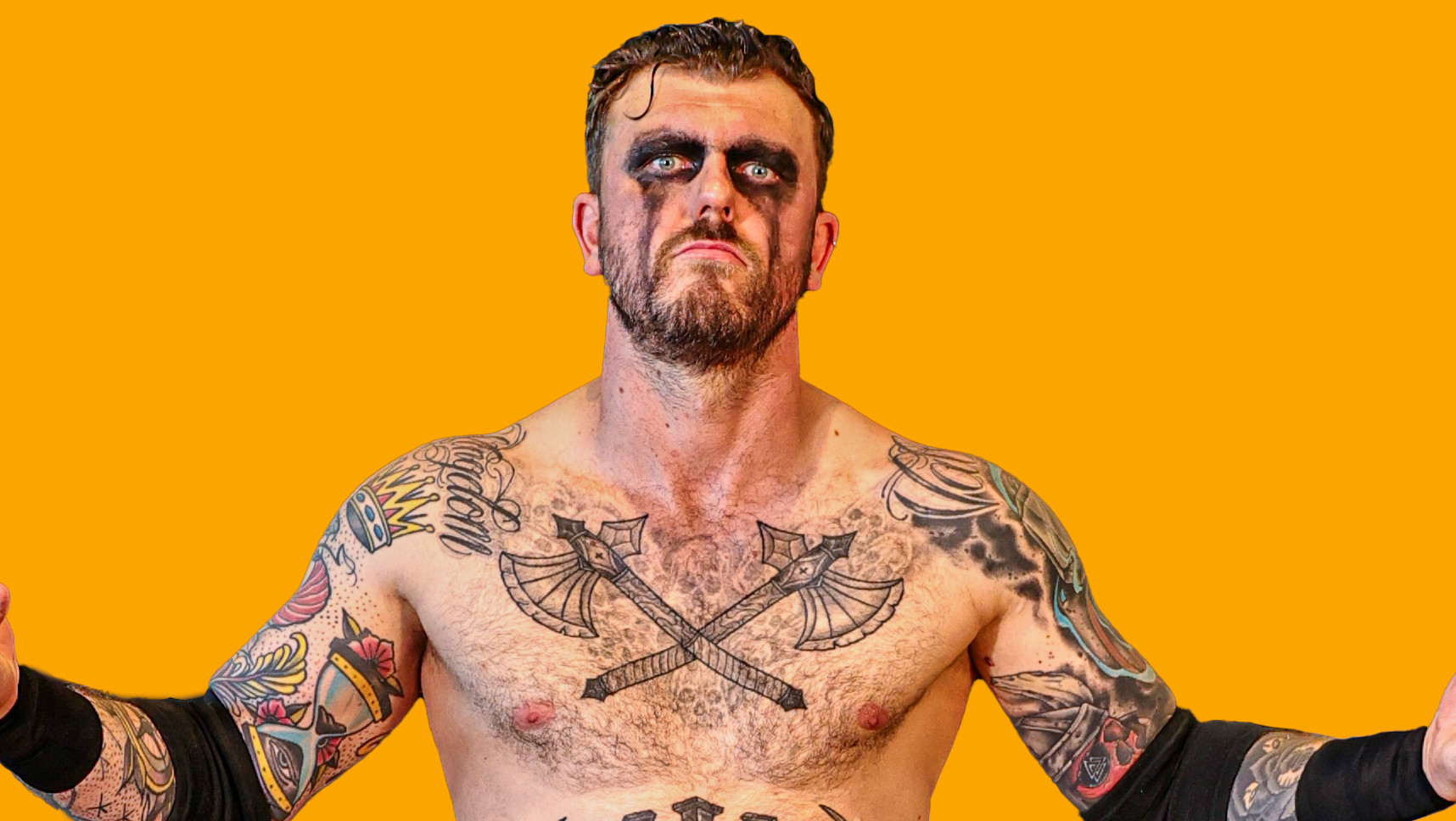
Image credit: @mandaminsnaps
He sat down with In the Gorilla Position to talk about a mother who accidentally made him love wrestling more, three months in a ring with Dustin Rhodes, a metal festival crowd who didn’t quite get him, a journal with every match he’s ever had written down in it, and why the scene being better when he leaves it matters more to him than any title he might win along the way.
He was uncomfortable watching wrestling as a child.
Not bored by it. Not uninterested. Actively uncomfortable, in the way a kid gets when something on television looks too real.
“I remember watching some matches and being really uncomfortable. Watching someone getting beaten up who I thought was getting beaten up for real. Even though it looked a bit hokey — if you’re a child you just accept what’s in front of you on TV.”
His best mate had introduced him to it. They watched it together when they could, which was harder than it should have been because pay TV in their household was intermittent. The family would get Foxtel, use it heavily for a while, then drop it when it felt like they weren’t getting enough value, then get it again. Wrestling came and went.
Then his mum sat him down and told him the truth about what he was watching.
“I think maybe in an effort to put me off watching it. Or maybe just an effort to be real. I’m not sure.”
The opposite happened immediately.
“Then it clicked. I was like, oh, OK. It’s a show. I can see that now. They’re performing.”
He went from uncomfortable to invested in one sentence. The knowledge that no one was actually being hurt did not diminish his interest. It expanded it. Because now he could see what these people were actually doing. The wrestlers were convincing an audience that something was real and the craft of that was suddenly everything.
“From even that age I was like, man, I really want to do this. I think I could do it.”
He grew up in Warwick, a regional town about two hours southwest of Brisbane. It is not a place where wrestling schools exist. It is not a place where a kid with that particular ambition has anywhere to take it.
So he did what kids do. He put it in the box marked childhood dreams, alongside people who want to be astronauts but grow up to become bankers.
“I’ve got a real job now. It’s just, would have been nice, but what are you going to do about it.”
The move to Brisbane came through good events, nothing dramatic, just the ordinary drift of a life finding a new centre of gravity. He was in his late twenties by then. Still not wrestling. Still not pursuing it.
Then one evening he watched Fighting with My Family.
He had not been burning for it. He streamed it because it was a wrestling thing and he was still, underneath everything, a wrestling person.
“I watched it and then I was just sitting at home afterwards and I was like, why aren’t I doing it? I’m sure there’s a wrestling school here somewhere in Brisbane.”
He Googled it. Wrestling schools in Brisbane have, he reports, terrible SEO. He could find nothing. There were heaps, as it turned out. He would learn this later, but from the outside, on Google, in that moment, they were invisible.
He got connected through a chain of people: his girlfriend’s best friend’s partner knew Seb the announcer for Pro League, who pointed him in the right direction. Within a year of that evening on the couch watching a film about Paige, he was in a ring.
“I was like, Yes! This is everything I ever dreamed it could be. Am I regret waiting so long to do this? I’m a hundred percent in.”
He debuted in August 2020. He has never had a different gimmick.
This is relevant because Jey Uso later became known for yeet. The timeline is frequently confused.
“August 2020 is when I debuted. I’ve never had a different gimmick. It’s the same gimmick I’m running now.”
He pauses.
“I was years before him. I don’t mind saying that. You can shout that from the rooftops.”
He is the lean mean yeet machine. He has been the lean mean yeet machine since before it was a thing anyone else was doing. He is fine with this being on the record.
A couple of years into his career, he hit a lull. He was wrestling, doing shows, and not sure what the next step was or whether anything he was doing was developing him the way it should.
He reached out to Mark Davis, who had spent significant time training the Queensland scene during COVID, stuck in Australia with the borders closed and genuinely generous with his knowledge, and asked for honest advice.
“He was very realistic and honest. He said, listen, I don’t think you’re quite good enough to get a lot of bookings overseas yet. Maybe think about going to a school.”
Which was correct. He knew it was correct. He appreciated that Davis had said it straight.
He found the Rhodes Wrestling Academy. Dustin Rhodes and his wife run it, and Alex speaks about it with the warmth of someone who found exactly what they needed at exactly the right time.
“They care so much about it. Which is fantastic! For someone who has been in wrestling as long as Dustin Rhodes has to still have care and passion for people at the ground level and just starting.”
The three-month program culminated in a showcase. There were students at all different experience levels in the room, trying to put matches together, and periodically Dustin would walk in on a conversation that had stalled and solve it in five seconds.
“We’re talking about things and there’s guys who are reasonably experienced and guys who are just starting, and there’s a few times where he’d just come in and be like, you should do this, this, this, this, this. And it’s just like, Yeah! That’s a great idea.”
The speed of it was the thing. Decades in every possible match situation, every possible crowd, every possible problem, distilled into an instant.
“I’ve thought of five solutions and here’s the best one. In five seconds. Happy to have it.”
He highly recommends the Rhodes Academy. He does not hedge on this.
He has been booked as a babyface for the majority of his career, and describes it as something he has generally benefited from. Particularly early on, when bookers put him in clear-cut situations where the crowd was set up to get behind him, and he just had to not fall over.
“They weren’t putting me in situations where a crowd could turn on me, which was great because I was new and I wouldn’t have known what to do.”
There is one specific exception. He has thought about it often since.
Slipknot’s touring show came to Brisbane. There were wrestling matches between bands. These were spot shows at the Brisbane showgrounds, a Knotfest crowd cycling through across a couple of days. Alex was booked in a match. His opponent was Snuff Daddy.
Snuff Daddy, he explains, is a large and physically impressive man who looks like he was built specifically for a metal festival. Big, jacked, masked and exactly the kind of presence that a Slipknot crowd is already primed to receive.
Alex is a babyface who comes out neat. White boots. Singlet. Combed hair and a tidy beard. He is, by his own description, not someone who looks like he belongs in a Knotfest crowd.
Both of them were working as babyfaces.
“The crowd didn’t turn on us. But there was definitely some apathy on my side. Because they were like: we love this guy, we love Snuff Daddy, he looks cool, he’s got the mask, he’s big and jacked. And it’s me, who’s like, yeah. He hasn’t done anything to offend us. But he’s just not the right flavour for that crowd.”
He knows exactly what he should have done.
“If I had my time again, I would have just recognised that during the match and turned, and been a heel. It would have made the whole thing better. I should have just been the bad guy.”
A babyface versus babyface match at a metal festival where one of them looks like he belongs there and the other one doesn’t. The crowd was never going to be even. The answer was right there in the dynamic, and he did not take it.
“That’s one of the few spots I can remember where me turning into the bad guy would have been the right call. Just to get them a bit more into it.”
He thinks about it often. What could have been.
He keeps a wrestling journal. Has since early enough in his career to have a complete record.
Every match: date, venue, opponent, outcome, a brief reflection on what worked and what didn’t. He heard Becky Lynch talk about keeping journals on a podcast and the logic landed immediately.
“Her point was just do it, because you never know when you’re going to need it. Once you forget about them, they’re gone.”
He had only had a handful of matches when he started, so he was able to reconstruct everything. The record is complete from the beginning.
What he has come to understand, thinking about it during the conversation rather than before it, is that the journal does something beyond record keeping. It gets thoughts out of his head and onto a page, which means they stop rattling around. The bad matches, the things that could have been better are noted, flagged for a coach if needed, and filed.
“I don’t tend to dwell on things in an all-consuming way. I kind of think about it, note it for later, talk to a coach about it, or try something different in training.”
He also watches his matches back. He does not love doing this. He does it anyway.
“Sometimes I enjoy watching it back. Sometimes I just do it like eating vegetables. You do it because you gotta. It’s good for you.”
He is not precious about criticism. He started this late enough in life to come to it with some perspective. He has already had an ego, already had it bruised in other contexts, already knows that the only way to get better at something is to look honestly at where you are falling short.
The thing he is working on most right now, the thing coaches have been prompting him on, is facial expression. His resting face is expressionless. Alex has been told this outside wrestling too, that he looks bored even when he isn’t. In the ring, what feels expressive to him still is not enough.
“What I think is expressive (feedback from coaches is) they couldn’t figure out what I was trying to get across. And it still wasn’t enough.”
He’s trying to find levels between zero and ten. Not just happy or yelling-angry, but the gradations in between. Variations like quietly furious, amused, calculating, rattled. The stuff that makes a face tell a story.
“There’s no room for subtlety in wrestling. But I am trying to be a little more subtle. There’s levels in there.”
When he was fifteen, he wrote somewhere that he wanted to be a professional wrestler. He carried that through his twenties, through Warwick, through the long gap between the dream and the doing.
When he finally started, he gave himself a definition. Not a glamorous one. A real one.
“What makes a professional anything is being paid to do something. Being paid for a service. What I arrived at was: I want to be paid to do a pro wrestling match.”
He was booked for Wide Bay Pro Wrestling. After the match, they gave him an envelope.
“I’ve got twenty dollars in an envelope. And I was stoked. I was honestly so happy.”
He made an Instagram post about it. He wrote to his fifteen-year-old self.
“Hey, fifteen-year-old me. We made it as a pro wrestler. Someone’s paid us to do wrestling.”
He cried a little. He is not ashamed to admit it.
“I’d spent so much of my life not thinking that was even a possibility. And someone did it. I had no care in the world whether people thought it was dumb or stupid. I felt completely free. Content. Someone had paid me money to do a thing I loved, and that made me a professional.”
Alex has done considerably more than twenty dollars’ worth of wrestling since. But that envelope is the moment he points to. That is where the line is.
He has been to the United States twice. He trained with Dustin Rhodes. He works up and down the Queensland coast and has crossed the border for shows in New South Wales. He thinks Australian wrestling is better than its international reputation suggests, and that anyone transplanting an average Australian indie show to most other markets would be competing comfortably.
He also thinks you cannot make a living from Australian bookings alone, and says so without bitterness.
“No. Not even remotely. There’s just no money in it. We don’t have a major promotion doing any kind of business or TV. The ceiling’s very low.”
The broader observation is more optimistic. Australians are performing at the top level internationally without having to live abroad the way previous generations did because wrestlers like Buddy Matthews, Rhea Ripley, Toni Storm have built their cases from home and exported them. That reputation, those proof points, make the path slightly less impossible for whoever comes next.
He mentions Brooksy going to TNA and Major League Wrestling as someone paving the road.
“Guys like that are making it easier for the rest of us to go overseas and say, hey, I’m Australian and I’m a wrestler, give me a booking.”
His own goals have evolved since those first sessions when he was convinced he would make it to the top and make a full-time living from it. Alex is more realistic now, and genuinely comfortable with that realism rather than resigned to it.
“My goal when I can’t wrestle anymore is I want to be able to look back and say: yes, I did everything I was capable of doing.”
He thinks about the end of his career, perhaps more regularly than most people his age in wrestling do. There will come a time, for everyone, when it is no longer possible. It may be chosen or forced, it is coming regardless. What he wants from that moment is not a title or a specific contract or a particular accolade. He wants to be able to say he achieved his potential. Whatever that turned out to be.
“Whether it’s I wrestled a bunch of local indie matches for a few people and that was great, or I got signed, or went overseas. Whatever I think my potential could be, if I’ve lived up to that, I’ll have made it.”
He is aware that he came into the Queensland wrestling scene at a pivotal moment. It was improving, becoming something more than it had been, and it did not improve by accident.
“It got good because a lot of people worked really hard to make it better.”
What he wants from his peers, when it is over, is a sentence.
“I just want people behind the scenes, in the scene, to say it’s better now than when he started. His contributions helped improve it. For more people.”
He is not specific about what those contributions will look like. He does not need to be. The principle is clear enough: leave it better than you found it, make room for the people coming behind you, be one of the ones who did the work rather than just showed up.
From the fans, Alex wants something simpler still. He was entertaining. They got their money’s worth.
That is it. Not famous. Not legendary. Not somebody’s comparison point in a wrestling history argument. Just someone who showed up, did the thing genuinely and well, and gave the people in the seats something worth having.
He started because a movie made him ask why he wasn’t doing it. He will stop when he has done everything he was capable of. In between, he is keeping a journal.
Alex Yeet Stevens, the lean mean yeet machine, competes across South East Queensland. He debuted in August 2020. He was yeeting before Jey Uso. The record will reflect this.
If you've read this far, please consider buying me a coffee! It's really expensive here in Melbourne.
comments powered by Disqus